Parashat Vayakhel

On Shabbat We Rest

shabbat

Harav Israel Asulin

Translated by Moshe Neveloff

Sunday, 19th of Adar I, 5776

BS”D

When, in the recent past, did you go on a vacation?

Vacation.  This phenomenon, which is an inseparable part of our routine in this generation, already has a culture and jargon and rules of its own.  It is rated as one of the most influential branches of the economy, which educational institutions set aside for it two months of the year. There are people who work hard all year just in order to be able to ‘go on vacation’ at the end of the year.  This idea of vacation, which people try so hard to obtain and invest in and look forward to; is it found only in bed and breakfasts, hotels, attractions and tourist sites?  Or can you also find it inside yourself?

When Hashem commands the Jewish people to keep the Shabbat, he speaks about it as if he was speaking about vacation: “For six days work may be done and the seventh day is a day of complete rest, it is sacred to Hashem… Between Me and the Children of Israel it is a sign forever that in a six-day period Hashem made heaven and earth, and on the seventh day He rested and was refreshed.” (Exodus, 31:15-17)

The Holy Shabbat.  This is a time of completely stopping the marathon of life with its never ending nuisances and noise, and entering a time of release and calm and holiness, moments of “He rested and was refreshed.”

Not long ago everything was on fire here.  Telephones rang, keyboards clicked, messages danced, screens flickered, pots boiled, the washing machine and the iron and the dishwasher and the oven and the bucket and mop were all active… buses blowing exhaust and trucks with their deliveries and shopping centers were alive and bustling…

And in one moment everything is silenced.  Everyone went on vacation.  All of the devices and  the transportation and the engines… it doesn’t matter what I was in the middle of, everything goes silent and disappears, because the Holy Shabbat has come down to the world, with a white table cloth spread on the table and quiet and calmness and love which are like the World to Come.

Shabbat.

How many songs have been written about it.  How many gave their lives for it over the generations.  How many hidden emotions it awakens in every Jew, who just agrees to feel them.  How much atmosphere and how much warmth…

What is the secret formula of the tranquility of Shabbat?  How does this Shabbat rest happen?

Accepting the reality.

During the entire week we are just trying to change and improve and make the reality better, and progress and climb and continue and take flight… on Shabbat we stop in our tracks.  We don’t move.  Don’t try.  Just rest.  We are happy and enjoying where we are.

Rebbe Natan explains: “Because the six days of work are lacking and they only have completion by way of Shabbat, which is the purpose of the creation of heaven and earth… the six days of the week only have life from Shabbat… and therefore they are the aspect of groaning over a lacking, because the main grasp of the groaning is during the six days of the week that are lacking the spirit of life.  Then we need to moan, in order to bring the spirit of life, and to complete the lacking of the six days of the week with Shabbat, which is the main life… because Shabbat is the aspect of completion.” (Likutei Halachot, Laws of Passover, 3rd teaching)

Shabbat is the reality of completion, of fulfillment, and the days of the week are the aspect of groaning and lacking.  It’s impossible without Shabbat, because without it we are also lacking the six days of the week!

Incredible!

The great Chassidic Rabbis say that just like we have Shabbat in actuality, here in the world of action, there is also “Shabbat in the soul”, inside every one of us.

What does the expression “Shabbat in the soul” mean?

Shabbat in the soul means receiving my internal reality as it is: ‘This is me, this is what is happening to me now.  I don’t criticize myself.  I accept my reality as it is.’

At first glance, this teaching seems to us to contradict a little bit the obligation to progress and the holy will to reach higher and be uplifted.  But truly it does not contradict, it builds you!

A person who comes to fix himself has to have in his soul a place of Shabbat.  Not all the time.  Not always.  Not only this.  This is not to say that we’ll continue to embrace all our nonsense and mistakes and failures and addictions and falls with extra affection: ‘I don’t criticize myself.  That’s the way I am, and I accept the reality as it is.’  No!

Rather what is the correct approach?

We work on ourselves.  We want to make progress and aspire with all our strengths to get there.  We check ourselves, we know our weaknesses and groan over them, we search where we made a mistake and try to correct it.  We are aware where we fell to and we begin again.  We educate our children.  We ourselves are being educated.  We don’t give up!  We want Hashem in our life.  We want our true selves in our lives.  We are not ready to live this life like an empty and hollow covering which doesn’t contain anything.  We want content in our life and truth and connection and giving and doing and overcoming.  We want, and we try with all our strength and without discounts!

However, at the same time, we must have the attribute of Shabbat in our soul.  It’s forbidden for us to be criticizing all the time where we are, rejecting ourselves, opposing ourselves.  We must have in our souls a place where we accept who we are and enjoy how we are and we love what we are.  A relaxed place, accepting, thankful, happy.  A place which from it we say: ‘Master of the world, it’s true that that’s who I am right now, but nevertheless, I’m yours!  And I’m always good, because I’m part of you!’

Like Shabbat, which blows a spirit of life into all the days of the week, so to regarding our personal growth: without this trait of Shabbat in the soul, of seeing the good without a speck of criticism, then, God forbid, there is no life in all of the feverish work and in all the beating ourselves up in the journey of coming closer!

You want to make progress?

Okay, wonderful, praise to you!

Go forward, all of the creation is waiting for your work!

However, before you go on the way, on the path of the six days of the week, don’t forget to equip yourself with a vacation package, the aspect of “He rested and was refreshed!”

Parashat Ki Tisa

Respecting Boundaries

boundaries

Harav Israel Asulin

Translated by Moshe Neveloff

Monday, 13th of Adar I, 5776

BS”D

This week’s Torah portion, Ki Tisa, opens with Hashem’s special request to Moshe Rabbeinu[1]: “When you take a census of the Children of Israel according to their numbers, every man shall give Hashem atonement for his soul when counting them, so that there will not be a plague among them… This shall they give- everyone who passes through the census- a half shekel of the sacred shekel… as a portion to Hashem.” (Exodus 30:12-13)  Hashem wants to count the children of Israel, but not by way of a regular counting, in order to keep away the evil eye; rather Hashem wants the count to be done in a secondary way through collecting from every person a half shekel and then counting the coins which have been gathered.

However, if counting the people is so dangerous, Rebbe Natan asks, why do they need to be counted at all?  What is the point of this count?  Behold Hashem knows his people and how many people there are!   What was so urgent in counting the Jewish people to the point that a secondary was was needed in order to do this?

“They were commanded to count them specifically, so that each one would be counted privately… so that they would not be mixed together, which would cause one person to enter the boundary of his friend… because even though all of the Jews are considered like one being- nevertheless, each and every Jew has his own limit and boundary by himself.  Every one’s opinion is different from his friends… and also each person serves Hashem according to his good character traits… and even though every Jew needs to receive from his friends’ good point, which is special to him… nevertheless it is forbidden to destroy the boundary… to enter his friends border, because sometimes even a good person can cause his friend to fall because of their differing opinions…” (Likutei Halachot, the Mincha prayer, 7th teaching)

It’s true that we are one people, like one person with one heart and one soul, and it’s also true that every Jew needs to receive from his friend from his special good point, and it’s true that there are in the world deep interpersonal relationships filled with closeness, but even so there needs to be a clear boundary which cannot be destroyed!

Every one of us is not only a part, he is also very much separate, with separate opinions, different traits, a special role, a specific way of serving Hashem, and in the same way that we are commanded to love friends, we are also commanded to respect a person’s boundaries and not to enter his space.

What does it mean ‘to enter the boundary of another person’?  What does it look like when people cross boundaries and enter the boundary of the other person?

When I’m controlling or I’m too dependent, this is called that I’ve broken a boundary and entered the space of someone else.  Because when I’m controlling or dependent I’m like someone who forces the person near me to behave in the way that I expect him to behave.

When a person controls someone else and makes him obey his opinion and his will, he causes tremendous damage!  Do you understand?  There is a pure soul here, with a specific mission, strengths and talents, and you move him from his path.  This soul needs to be an artist, what are you doing sending it to work in plumbing?  Have mercy!   Have mercy on this soul and upon its role which is waiting for it in vain by the paintbrushes.  Have mercy on it because instead of being in its place and carrying out its role, you are busy whipping imaginary horses that will continue to run on the paths you have drawn for him.

Okay, I understood that to control the other person is terrible, but what is the problem with the fact that I’m terribly dependent on somebody else?

Also when I enter the mold of being completely dependent on someone else I make him against his will play for me the role of a certain character, who will fulfill for me the expectations I have of him: be the mother for me that I didn’t have; be the father who I always wanted; and you, forget all together that you are my daughter, because we waited all these years for a son, so let’s see you be like a boy…

However, hello, I’m your wife, I’m not your mother!  We need to relate to each other as mutual partners, I need your support, I need you to be mature with me and not like a small child who’s looking for his mother!  Yes, we can have quiet time in the evenings and have a deep conversation relating to the small child who terribly misses his mother.  But right now we need to face the educational problem our child is having and the overdraft we have in the bank, you can’t disappear on me and put on a bib like a child, whose whole existence depends on his mother!

In a deep way, both control and dependence lead to exactly the same point, crossing the boundary of your friend or spouse!

Whether you control and force your wife or your children or your workers to think like you and submit to your desires or whether you are dependent upon her or him or them to the point of fear and you place upon them your expectations and your own feelings of neglect and neediness; in both of these cases you are crossing the line, you are entering a place which is not yours, you are making someone else behave according to what you dictate and not according to his internal will, you cross the boundary!  This crossing the boundary contains in it a lot of pain, anger and frustration, because “each and every Jew has a limit and boundary by himself” and “it is forbidden to destroy the boundary!” (Likutei Halachot, ibid)

So what can be done? Doesn’t ‘don’t be controlling and don’t be dependent’ mean in other words to be socially isolated?

No!  It’s possible to live a life of full, close and good interpersonal relationships, without control and without dependence!

You need to understand that blurring the boundaries between us happened in a hidden way, unconsciously and without bad intention; underneath the surface, like secret notes which were passed under the table, without anyone speaking about them out loud, everyone was forced to act according to them quietly.  Therefore, first I need to identify where I destroy my boundaries and those of someone else, which roles I place upon my wife and what expectations I burden upon my miserable children… and then, to place anew and in a clear way the roles and exact boundaries of each person in the family.  Here I’m a spouse, there I’m a child, and here I’m a parent.  There are times when I’m a friend, places where I’m a neighbor and times where I’m a worker or a boss…

These renewed boundaries in my connection with my wife, my children and with those who surround me will give me much more than what I obtained when I entered their boundary and acted dependent or controlling.  They will open for each of us a place of respect, which is defined and stands by itself.

[1] Our Rabbi, Our Teacher

Parashat Tetzaveh

Connection

So many Jews spend years upon years in treatment after treatment, go from one method to another, from coaching to meditation, from a psychologist to a psychiatrist, from CBT to DBT to NLP, from Prozac to Prozac plus Clonex…

But the soul will not become fulfilled.  It’s true, there is a little bit of relief.  For sure.  But in the big picture- the feeling is that that’s not it and the lacking continues to eat away at us.

holy temple

Harav Israel Asulin

Translated by Moshe Neveloff

Monday, 6th of Adar I, 5776

BS”D

Once, maybe not so long ago, there were people who felt healthy.  People who learned in order to become wiser and not in order to find themselves; they searched for money in order to become wealthy and not in order to quiet the angry tiger inside of them; they searched for food in order to enjoy it and not in order to escape the pain which is making them go crazy… and if we would quote for them Rebbe Nachman’s words that “the main aspect of exile is in the soul”, they wouldn’t understand what we are saying.

Today the situation has changed.  We all feel this exile, which from moment to moment deepens our feeling of lacking, of longing, of searching, and it doesn’t leave us with a lot of choices, except to feel the pain and to search for a cure…

This is the reason that in this generation we are all searching to be healed.  Some of us, indeed, are searching for the healing in an unhealthy way: in money, food, alcohol, drugs, and movies.  However internally, this is what we want the most and what we are all running after- to be healed!

And we don’t understand why every type of treatment doesn’t fully succeed in helping us.

So many Jews spend years upon years in treatment after treatment, go from one method to another, from coaching to meditation, from a psychologist to a psychiatrist, from CBT to DBT to NLP, from Prozac to Prozac plus Clonex…

But the soul will not become fulfilled.  It’s true, there is a little bit of relief.  For sure.  There is also a little bit of improvement.  But in the big picture- the feeling is that that’s not it and the lacking continues to eat away at us.

Why is this?

“Now you shall command the Children of Israel” (Exodus 27:20) – with these words the Torah opens the portion which talks about the service of the Temple, and seemingly, it sounds like a simple command, Hashem tells Moshe to command the Jewish people.  Is there special meaning to these words?

“Command”, says Rebbe Natan, is not just the language of an order.  “And this is what it means: ‘Now you shall command the Children of Israel’- ‘command’ is the language of connection.” (Likutei Halachot, Laws of breaking bread, 5th law) Command also means to team together, to connect.

What did they connect in the Tabernacle and the Holy Temple?

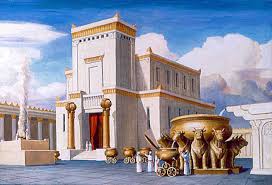
The Temple was the place where worlds connected, heaven and earth, upper worlds and lower worlds, holiness and secular.  The Temple included everything, surrounded everything and was a very exceptional place.

Imagine for a moment that remnants of authentic videos were found at an ancient site from inside the Temple, and now they are being shown to you.  The camera lens hovers over from above, scanning this great place from a distant view, and then the zoom goes into action, everything grows, comes closer, and you are inside the Temple.

What do you see?  The Temple, which we are longing for already for thousands of years, the place from where knowledge went out to the world, the place that without it we are so compressed, squashed, restricted in the chains of the exile of knowledge and the soul.  This Temple is presented before you, and what do you see there, in the ancient film the archaeologists found?

Flesh and blood.  Kohanim up to their knees in puddles of blood, throwing blood upon the altar and eating a large amount of meat in one meal…

What is this?  How is possible to understand something like this?  What is the connection between the place where God’s presence dwells to these physical effects?  “You shall command”, that is the connection.  That is the deepest essence of the Temple, to connect the extremities into one complete experience, comprehensive and united.  To make God’s presence dwell in this world and to send out knowledge to the whole world amongst flesh and blood.

However it doesn’t just remain there.  Hashem comes and requests from us: “They shall make a Sanctuary for Me- so that I may dwell among them” (Exodus 25:8) – this connection in the Temple shows you the connection which is supposed be made inside every one of you.  “That is to say that you should command and connect and unify the Jewish people…” (Likutei Halachot, ibid)

What are we required to connect?

The Vilna Gaon explains in his commentary to Proverbs: “Heaven and earth, and man who connects them” (Proverbs 1:2) – a person is meant to make the same connection of extremities between heaven and earth.  Heaven refers to the higher part of the pure soul inside every one of us, with all of the knowledge and truth it contains; the earth is our lower, pained, soul, with all of the small and childish needs it contains; and we came to this world to engage in this amazing work, which is called ‘man who connects them.’  The purpose of the creation is to create man.  To make the proper connection between heaven and earth inside ourselves.  To be in a continuous and balanced movement between the higher and lower soul.

Why is this considered something so important?  Why is this the purpose of creation?  What is the problem in making this connection?

Because the painful longing and the burning lacking cause almost everyone today to look for change.  Where?  In one of these extremities- to receive emotional help of any type or to come close to Hashem and the Torah, but only one of them; the lower soul or the higher soul.  To deal with only the emotional needs of our lower soul or to fill only the spiritual needs of the higher soul, and when you catch one end and get stuck on it- you’re still missing something.  There is still not a connection, there is no Temple and not God’s presence.

Indeed, it’s true, a soul in pain prevents a Jew from being present in the world and from fulfilling his special purpose in it, but emotional help is not the only thing he needs.  In parallel he needs also precise spiritual guidance, to get to know the Creator, to receive upon himself the yoke of Heaven, and an inclusive service of Hashem which will connect all of his parts; the lower soul, the spirit and the higher soul.

This is the reason that no psychological method will be sufficient and it will not fulfill you- because a Jew needs “You shall command”, because in the process of healing a Jew, who is unique, the focus is not just on his lower soul, rather to the entire Jewish experience.

We are Jews and our soul needs the boundaries of the holy Torah, not as an addition, but as an essential part of the healing.  These boundaries will protect the soul and help it heal, and furthermore without it the soul will remain exposed to continuous injury which will delay its healing.  In order to truly heal we need emotional help and also personal prayer, dealing with internal blocks and also making progress with keeping the mitzvahs, coming closer to our internal self and also coming closer to Hashem, and mainly- to finding the proper balance between these two parts.

In order to feel that our feeling of lacking receives an answer, it’s necessary for us to receive help which includes all of these aspects, which connects the blocked depths of the lower soul with the light of the higher soul and turns our pained and chained imagination into pure truth, which is clarified and free.

Until with God’s help, slowly, there will be developed inside of us the lofty creation which is called ‘man’.

Parshat Terumah

To Illuminate

Hashem loves your new beginnings, the tremendous amount of times you overcome the ego and the embarrassment, when you get up and say: “It doesn’t matter what was, it doesn’t matter how much I’ve fallen, I’m starting anew!”

menorah

Harav Israel Asulin

Translated by Moshe Neveloff

Monday, 29th of Shevat, 5776

BS”D

Light.  An abstract concept, elusive, impossible to define; spiritual light.

What is this concept?  Does it have a chance in our lives?  We, who were born in frozen fields of darkness, in the most remote and dim depths, amongst giant shopping centers which numb our senses, far from any little bit of sanity and rest, deep in the depths of the exile of the soul and knowledge, we can be enlightened?  What does it mean to be enlightened?  It sounds a little bit mystical or like a fable, those words- ‘light’ ‘holiness’; is it something which happens here, in this world, to people like us, in our regular and tiring lives?

For the sake of truth, we are not the only ones who wonder about this matter, Moshe Rabbeinu[1] himself already had difficulty with it.

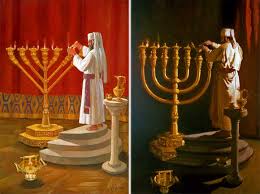
When Hashem showed Moshe the structure of the Tabernacle and commanded him, “They shall make a Sanctuary for Me- so that I may dwell among them” (Exodus, Chapter 25, Verse 8), he detailed for him the specific components and the final shape of all the vessels of the Tabernacle, however, regarding the Menorah He gives him a special instruction, which sounds complicated to the point of being impossible: “You shall make a Menorah of pure gold, hammered out shall the Menorah be made, its base, its shaft, its cups, its knobs, and its blossoms shall be (hammered) from it” (Exodus, Chapter 25, Verse 31).  Rashi[2] explains regarding this verse: “It all came from one piece.”

How is it possible to create a Menorah which is made up of so many parts, when it all comes from one piece of gold?

Surely, Moshe found it difficult to make the Menorah more than the rest of the vessels of the Tabernacle.  “Because it was difficult for him, Hashem said to him: ‘Take a piece of gold and throw it into the fire and remove it.’  What did Moshe do?  He took a piece of gold and threw it into the fire and said: ‘Master of the world, behold the piece of gold is in the fire, and just as you wanted me to do this, so to make the Menorah,’ immediately the Menorah came out of the fire completely finished.” (Midrash Tanchuma)

So to regarding the light and the holiness in our lives, which the Menorah represents according to Rebbe Natan[3], because how can physical people like ourselves merit light and holiness?  Is it in our power, to create a menorah of pure gold and to illuminate through it the darkness of this world?  How do we do this?  How do we create it?  How do we pound out so many cups, knobs and flowers?  How do we make it precisely until we reach the perfect completeness?  How can we be illuminated already, pure already, for the sake of Hashem?

The answer is, that it really is not in our power, and we don’t make and create and pound and be precise in order to reach completeness…

What is correct then?  What in any case is can we do in order to kindle the light?

Our part, and the only thing that we can do, is to throw a piece of gold into the fire- to make our best effort and to pray for help from Hashem.

The rest Hashem does.

What in any case is the effort that we need to make in order to merit God’s light?

Rebbe Natan says: “hammered out shall the Menorah be made”, in order for the light to come, you need a hammered out single piece of gold, stubbornness like steel.  “Someone who has begun a little bit in the service of Hashem knows this, that it’s impossible to truly be a Jew without a great level of stubbornness.  Because there are many trials and ascents and falls which each person needs to go through without measure.  If a person will not be greatly stubborn to not let go of the small amount of his service which he has begun, it’s impossible to remain in his place.” (Likutei Halachot[4], the Laws of Bircat Hamazon, 4th halacha, 12th paragraph)

You want light?  You want a life of holiness?  You want to make inside yourself a tabernacle for Hashem and light the menorah of your life?

Be stubborn!!!

It doesn’t matter what you are going through, and even if you have tried thousands of times and failed.  Even if after years you find yourself in the same stinking garbage dump.  Even if you ascended and descended, again and again, without measure.  Even if it seems to you that Hashem doesn’t look at your service, that you are not worth anything, that you are not successful.  Because, really, how many times can a person declare “from now I’m on a diet” and finish the week increasing his weight?!  How many times can a person decide to dedicate himself completely to healing his wife, and find himself again in the same trivial argument?!  How many times can you fall asleep during personal prayer, which was supposed to be a time of loud voices and thunder and awe of Hashem?!

Also then- the Tsaddikim request of us- don’t be impressed by how much you’ve fallen!  Be stubborn!  Don’t stop!  Begin anew!  Try again!  You don’t know how much Hashem loves your new beginnings, the tremendous amount of times you overcome the ego and the embarrassment, when you get up and say: “It doesn’t matter what was, it doesn’t matter how much I’ve fallen, I’m starting anew!”

“And this is the main pride which Hashem receives from the Jewish people.  Because Hashem has great pride from the daring and the stubbornness of a Jew, who they knock down every time and he strengthens himself all the time and he is really stubborn and doesn’t allow himself to fall in any way.” (Likutei Halachot ibid)

Hashem does not receive pride from the fact that you don’t fall!  You indeed fall, but you don’t allow yourself to fall in your spirit, to be broken from this, to leave the game!  In this you are great and in this Hashem receives pride from you!

This is our effort, this is the matter of throwing a piece of gold into the fire- from the strength of this dedication we throw ourselves again and again, whether it be life or death, embarrassment or pain, with impressive stubbornness and courage, and we begin again.

There, inside the fire of this stubbornness, the Menorah will be made by itself, with all the light, the holiness, the purity and the beauty which pours out!  Because “from its base to its flower” (Numbers, Chapter 8, Verse 4), Rebbe Natan says, until the light of the redemption will grow and shine.

[1] Our Rabbi, Teacher

[2] A major Rabbi of the Middle Ages, wrote a commentary on all of the Bible and Talmud

[3] Rebbe Nachman’s major disciple

[4] Rebbe Natan’s explanation of the Shulchan Aruch (Code of Jewish Law), based upon Rebbe Nachman’s teachings

Parashat Mishpatim

Everything Depends on It

Truth is the main principle which everything depends on!  All of the work of personal development depends and relies upon truth!  If you don’t have this honest will, to reach the truth, then there is no reason to begin the work.  Why?  What is so critical about being truthful or not being truthful?  What, it’s impossible to make progress and come closer while continuing to tell small or big lies?

truth

Harav Israel Asulin

Translated by Moshe Neveloff

Monday, 22nd of Shevat, 5776

BS”D

In all of the Torah- five books, 5,845 verses, 613 mitzvahs- in all of them there is only one time that the Torah asks us explicitly to distance ourselves from something:  “Distance yourself from a false word.” (Exodus, Chapter 23, Verse 7)  It’s not just that you should not lie, it’s much more than that- distance yourself from lies.  There is no parallel to this commandment in all of the Torah.

Why?  How can it be that even regarding fundamental mitzvahs like the Ten Commandments or the Seven Noachide laws, the Torah used a matter-of-fact and focused language of positive and negative commandments, and only regarding lies the Torah uses such strong language?

In order to understand this, it needs to be understood what is a lie?

We all know that a lie is anything which is not true, but what is truth?

“The main principle which everything depends upon is truth, to walk in the path of truth according to his level, because the seal of Hashem is truth, and it is the foundation of everything, because truth is the beginning middle and end…” (Likutei Moharan, Torah 112)

Truth is the main principle which everything depends on!  This matter of truth and lies is so basic and central and meaningful to the point that it meets us in all aspects of life, and all the more so when talking about personal development, when we want to come closer to ourselves and to Hashem.

When a person comes to work on himself, the main thing that needs to guide him on this journey, before everything and amongst everything, is truth.  All of the work depends and relies upon truth!  If you don’t have this honest will, to reach the truth, then there is no reason to begin the work.

Personal growth is for a person who wants the truth and agrees to meet it, and it doesn’t matter how it appears.  It’s true, I don’t know what I’m going to reveal about myself on this unknown journey inside myself, but what I’m looking for, first and foremost is truth.

Who am I really?  Not- who is my poster!  Not- what is the image that I built for myself with years of work!  Not- what do they think of me and not how do I look!  Rather, who am I truly?  What’s going on with me?  How I am doing right now?  Where am I actually?  With myself?  With my wife?  My children?  My family?  My friends?  What I am supposed to attain according to the truth?

When I strive for this deep truth, I’m happy with any revelation about myself, even if it hurts and is not polished and doesn’t look good in a picture and is not heroic like in my dreams.  Because truth, Rebbe Nachman says, is the key: “Through truth a person merits to find the opening… and through truth Hashem dwells with him (Likutei Moharan, Torah 9); and for truth I’m willing to sacrifice myself, to put myself in danger, and to examine from anew my life, even if I’m likely to reveal that all of my life is one big lie and that I need to build everything from the beginning and to separate myself forever from the external image, which has accompanied me for years, in favor of the true self.

To lie is the easiest thing to do.  Every one of us has a doctorate in lying to himself and to the whole world, however as much as the lies are destructive in all areas of life, when talking about personal development and growth- there is nothing more ironic than lying.

Why?

Because it’s impossible to make progress with lies!  Without truth you can wander around for years with imaginary attempts to help yourself, without moving a millimeter.

Without truth, you look, for example, every evening at the scale and don’t understand the number that you see.  Maybe the scale is broken?  What did you eat today?  Nothing, really nothing!

Without truth you have no chance of meeting the child inside of you, because why would he trust someone who lies to him?!  It’s enough that they lied to him all his life!  Why would he fall again into this trap?!

Without truth, in most cases you won’t feel what hurts you.  Because, it’s true, life is humdrum… but this pain, which is sharp and cutting, which causes you to scream “I’m weak and I need help”, which pushes you to stand up with courage and decide to change; pain like this is very far from you, and so to also the change.

So what can I do if I lie?  I understand that truth is the key to making progress, but I feel, that the lies are welded to me and accompany me already for many years like a true good friend- how can I separate from them?

You need to know that lying is only a matter of a bad habit: “When somebody repeats the lie twice, it becomes truth for him.” (The Life of Rebbe Nachman, paragraph 550)  Nobody is born a liar!  We were all born truthful and holy and pure!  Inside every one of us there is found the point of truth, but it functions like a muscle, that when there is a lack of use it is likely to shrink and become weak, but it is always possible to build the muscle anew, to go back and use it, to give it light and let it grow.

From this faith you will be able to reveal the roots of your lies.  You don’t lie for no reason!  You have inside of you a reason for lying.

Again you caught yourself lying a big or small lie?  Come, sit for a minute quietly and ask yourself: “Why do I lie?”  In the same breathe ask yourself too:  “What am I afraid of?”  Because this is a very great secret, that all of our lies come from fear.  The great and terrible fear of a small child in a big and pressuring world which requires an endless amount of arbitrary requests.  So clarify to yourself: “What I am so afraid of that I fall into lying?”  In this way you will reveal the fear, which controls you and causes you to beautify the reality and to ignore the pain and to shake off guilt and to close your eyes to your actions.  The fear of the small child who is sure that he is bad or guilty or mistaken or not okay or not in the right direction, and in any case, lacking any chance.

After you meet this fear, which distances you from the truth, you’ll reveal your inner child, and above this truth there is a deeper truth.

The deeper truth says that as much as you messed up and fell down and made mistakes and got dirty and were not okay, at your root you are completely good.  You are part of Hashem.  You are God’s only child.  You are beloved and important and good!  So good, that you have no idea!

Therefore the fear is unnecessary, and so to the lies.  Because what is the truth?  That everything you will reveal about yourself along the way does not take away from your value and does not cause you to appear unclean; it just helps you come closer, a bit more, to Hashem.  Truthfully.

Parashat Yitro

Amidst the Fog

To look the thick cloud in the eyes and say: it’s true, I’m terribly confused right now and I don’t know what I need to do.  That is my situation right now, a situation of doubt and uncertainty.  It’s okay that I don’t know.

fog

Harav Israel Asulin

Translated by Moshe Neveloff

Tuesday, 16th of Shevat, 5776

BS”D

This world is called ‘olam’ from the language of concealment, because there are more things that are hidden to us than are revealed.  Since the world conceals and hides things from us, we feel fear because of this lack of knowledge, afraid of the lack of certainty, we shake from every confusion, and we pay good money in order to make a living with a sense of certainty.

Life brings us many uncertainties, on the practical level and also on the emotional level, beginning from technical and small things and ending with big and meaningful questions: Should I move to this apartment?  Do I need to take a mortgage for the rest of my life?  Should I rent for the rest of my life?  Should I close the business?  Should I invest all of my savings in this stock or not?  Should I open an independent business or remain a salaried worker the rest of my life?  Should I continue the studies or stop them?  Should I begin this new job?  Should I stop working?  Should I choose this person to be my spouse?  To which educational institution should I send my child?  Should my child skip a grade?  Should I leave my child for another year in kindergarten?  Should I continue to devote and invest myself in this faltering marriage or go to the rabbinical court (to file for divorce)?

How many uncertainties fill our life, how many questions, and how many issues at every step…?

How do we live with them?  How do we relate to them?  With calmness?  With love?  With happiness?  Or do we relate to them as temporary discomforts which need to be solved quickly?

In most cases we experience the dilemmas in our life as real crises.

The big question is why?  Why do we make a big deal about it?  Seemingly, okay, we have difficult decisions, there are considerations to both sides, in the end the issue will be decided in favor of one of the options; so what’s the story?  Why is it so hard for us to be in doubt, to remain with a question?

We can’t suffer the feeling of not knowing.  This doubt causes us to feel in distress, because we can’t breathe for such a long time without knowing!

Enough, just make a decision already!

And if you don’t know what to decide?

Just decide!!!  Be decisive!  Flow with it!  The main thing is to do something!  Press on the gas and get going already!  Don’t remain trapped in this fog, don’t even enter it, go around it!  Understand me, I can’t find air in this darkness!  In the darkness there are monsters, when we got lost we find wolves, I remember this from when I was still small… so do me a favor, let’s escape from here to the light.  Just don’t remain here!  I’m choking and terribly afraid!!!

We get married without knowledge, get divorced without thinking, and manage meaningful relationships superficially.  We make mistaken decisions because of the fear to be unsure, make quick choices and go through life with choking pressure, terrified.  We slow down for any piece of information and find in it support and comfort… and the main thing is- to decide, to take a side, to solve the question.  Not to be in doubt, G-d forbid.  Not to remain ‘in midair’…

Regarding the verse, “The people stood from afar and Moshe approached the thick cloud where God was” (Exodus, Chapter 20, Verse 18), Rebbe Nachman teaches:

“A person who lives a life of physicality all his days, and then becomes intrigued and wants to walk in the ways of Hashem- the attribute of judgement brings judgments upon him and doesn’t allow him to walk in the ways of Hashem and brings upon him obstacles and hides himself in this obstacle.  Someone who has knowledge- he looks in the obstacle and finds there the Creator, blessed be he… and someone who does not have knowledge- when he sees the obstacle he immediately goes backwards.

And the obstacle is the aspect of a cloud and fog, because clouds and fog, that is to say darkness, (darkness) is the language of obstacle… and this is the meaning of the verse: “The people stood from afar”- because when they see the fog, that is to say the obstacle mentioned above, they stand afar.  ‘And Moshe’, who is the aspect of the knowledge of all of the Jewish people, ‘approached the thick cloud where God was’- that is to stay to the obstacle, that in the obstacle itself Hashem is hidden… and one who has knowledge can find Hashem inside the obstacles themselves, because truly there is no obstacle in the world at all, because in the midst of the obstacles themselves Hashem is hidden, and by way of the obstacles specifically someone can come close to Hashem.” (Likutei Moharan, Torah 115)

It is now clear that our hysterical inclination to hold on to what is clear and known is strongly inside of us and it negatively affects our service of Hashem.  We want to do good, we want to come closer to Hashem, but then a chunk of darkness falls upon us, of lack of certainty, and all that is left for us is to say: “Oh, sorry, that is not what I intended”, to go in reverse or bypass the uncertainty, and to keep going, standing far from Hashem, as far as possible, in the certain and known comfort zone.

That is how we are.

However the Tsaddikim, in contrast, who know the secret of the world, are not scared by the darkness.  They don’t escape.  They don’t distance themselves.  They enter the thick cloud, because they know that there, and specifically there, Hashem is found.

And this secret they reveal to us and teach us to enter the darkness, without fear, in order to meet Hashem there.

What does it mean to enter into the fog?

It means to agree to be uncertain.  To look the thick cloud in the eyes and say: it’s true, I’m terribly confused right now and I don’t know what I need to do.  Here there is darkness which silences and conceals, and against it I feel helpless and scared of the unknown.  That is my situation right now, a situation of doubt and uncertainty.  It’s okay that I don’t know.  I don’t have to know everything.  It’s also permitted for me to not know anything.  I’m not running to light an imaginary light with hasty and quick decisions; I’m remaining inside the darkness with submission and acceptance.

It’s true, I don’t know what will be and where I’m going.  I don’t know the way and can’t see anything in the darkness.  However, I’m not sitting in the driver’s seat, rather my father is, and I’m his small child, seated in the car seat in the back, I don’t need to do anything or see anything.  My father knows the way and he’s caring for my needs and driving me, also amongst the darkness.

Helplessness is a very big gift- if we are not scared of it, because then faith enters the picture.  When somebody isn’t afraid of the unknown and allows himself to be in this experience of helplessness, of weakness, of being in doubt, suddenly this experience turns the person into the most relaxed and calm and connected person, because there Hashem is found.

Parashat Beshalach

Follow Moshe

Like the first rain which comes after long years of drought, Moshe’s whispers are still trickling… bringing water slowly to this tired and thirsty generation, revealing to anyone who is willing to hear: “Precious friend, I am the messenger of Hashem to redeem you.  I am the healer of the souls, this is my role.  I can help you.  I can lift you up even from the lowest depths.  Just follow me.”

leaving egypt

Harav Israel Asulin

Translated by Moshe Neveloff

Monday, 8th of Shevat, 5776

BS”D

The internal journey which the Jewish people went through in the Exodus from Egypt tells us the exciting story of our faith, which has no comparison in the world: “and they had faith in Hashem and in Moshe, His servant.” (Exodus, Chapter 14, Verse 31)

The Jewish people went through generations upon generations of slavery in Egypt, years upon years of servitude and difficulty and loss of awareness; it was almost erased from their memories the ancient, distant and sweet promise, which said: the day of redemption will come…

Amidst this situation, one clear day, Moshe arrives from Midian, walks between all of the depressed prisoners and declares: “Beloved brothers, I am God’s messenger, and in his name I say to you that the redemption is at hand.  Soon he will free you and redeem you and take you out from this terrible place and take you to another place, which is good and nearby, and he will choose you to be for him a special people and give you the Torah as a gift…”

And they believed him!!!

For two hundred and ten years they were amongst the filth of Egypt!  Not only were they slaves to Pharaoh, so too their father, grandfather, and the grandfather of their grandfather… generations of slavery.  A tradition of slavery… suddenly one day someone named Moshe comes and says to them:  “It’s over”, and they believe him!

From the strength of that faith they merited to see with their eyes how Hashem brought the ten plagues upon Egypt, with great miracles, and how Pharaoh expelled them from being his slaves, pleading with them to leave Egypt already to go and serve their God, and how in the end the surprising freedom came… and all along the way they continued to believe- a entire people stands at the gates of Egypt, disconnects from hundreds of years of slavery and servitude, and goes out a new path.  Men, women and children, with possessions of great wealth and dough which did not have time to rise, in their hearts they are departing for ever from Pharaoh and his slave masters, in their eyes they see a picture of the dreamed for and promised land… but how?  And where are they going from here???

Moshe says to them, “Come after me”, and they believe.

Apparently there were all types of Rabbis and learned people in that generation.  Surely there were also all kinds of wise men, who were experts in geography and the maps of the world, and they were familiar with international politics and foreign relations, and experts in weaponry and war strategy… each person in that generation could have said: “Okay, let’s say that Moshe is a tremendous Tsaddik and he showed us great miracles, but why walk after him specifically?  What if I know a shorter route to the land of Israel?!  I myself am from the Jewish people, a descendant of Avraham, Yitzchak, and Yaakov, correct?!  And behold Hashem said that he will redeem the Jewish people, so that’s it, why do we need Moshe?  Why do I have to walk after him specifically?  I am smart enough and know how to walk!  Why can’t I do it by myself?  Maybe he’s completely mistaken about the route??”

A great level of faith and submission was needed in order to walk after Moshe!

And they?  They walked after Moshe!

They continued walking after Moshe, and continued, even when seemingly because of him they were entering a terrible, threatening and terminal death trap- Pharaoh and his 600 soldiers on horseback closing in behind them, and the sea was in front of them like a wall, deadly animals were threatening to swallow them alive in every direction, and the Jewish people were like “a dove which escaped from the hawk and hid in the cracks of the rocks, and there was a snake hiding there; the dove wanted to leave- behold the hawk was waiting at the entrance.  This is how the Jews were- the sea was raging before them and the tyrant was pursuing after them and so to the animals of the desert… they were surrounded in four directions…” (Midrash Tanchuma, Parshat Shoftim, 13)

Also in this difficult and impossible situation the people continued to believe and walk after Moshe.  Hashem says to Moshe: “Why do you cry out to me?  Speak to the Children of Israel and let them journey forth!” (Exodus, Chapter 14, Verse 15)  This is exactly what they do, they enter into the sea!  Somebody needs so much courage to do something like this!  It takes so much faith in order to enter the sea!  Because Moshe said…they believed.  “And they had faith in Hashem and in Moshe, His servant.”

Thousands of years afterwards, the same exciting situation of unexplainable faith is taking place.  Only this time we are the heroes; Jews of the 2000s, sunken to our necks in the filth of Egypt, serving Pharoah with dedication and trying to remember: “What was that, that promise?  They said that one day the Moshiach[1] would come and there will be redemption… did they really mean it or was it just a parable?  Is this something that will ever happen?  It’s a bit difficult to believe… it sounds so unrealistic and impractical…”

Like the first rain which comes after long years of drought, Moshe’s whispers are still trickling… bringing water slowly to this tired and thirsty generation, revealing to anyone who is willing to hear: “Precious friend, I am the messenger of Hashem coming to redeem you.  I am the healer of the souls, this is my role.  I can help you.  I can lift you up even from the lowest depths.  Just follow me.”

“The night before he passed away, Rebbe Nachman said to his students: ‘What do you need to worry about, for I am going before you?  What about the souls who did not know me at all and are waiting for my rectifications, even more so for you.” (The Life of Rebbe Nachman, Paragraph 225)  “Even after he has passed away, someone who will come to his gravesite, and say there these ten chapters of Psalms[2], and give a small amount of money to charity in his (Rebbe Nachman) memory, even if his sins were very great, God forbid, then I will try (Rebbe Nachman) and make a great effort to save him and rectify him…” (Rebbe Nachman’s Wisdom, Paragraph 141)

It sounds a bit crazy.  It really contradicts all of our regular viewpoints.  What, from saying ten chapters of Psalms it is possible to have a salvation?  How can we leave Gehinnom[3] by visiting the gravesite of a Tsaddik?  Why be happy if I’m sad?  Who says that it’s permitted for me to make myself happy after I have sinned?  Why do I need to do it specifically his way?  It’s not possible by myself?  Who said that this is the path, maybe there are shortcuts?  We don’t understand anything!  However, we are all waiting for the sea to be split for us so that we can pass through it and receive the Torah; the same faith is waiting for us, that we will see it and believe in it… because “by way of faith by itself we can merit the aspect of the Splitting of the Sea.  The main aspect of the Splitting of the Sea for the Jewish people was through faith… because by way of faith in Hashem and the true Tsaddik (Rebbe Nachman) we can merit.” (Likutei Halachot, Laws of Torah learning, 3rd Halachah, 8th paragraph)

We have it, and we can do it, like our ancestors in Egypt- without asking questions.  Without arguing, without understanding.  Just walk after him, with closed eyes and with burning love which doesn’t expire; to see and to believe.


[1] Messiah

[2] A special rectification of ten chapters of Psalms that Rebbe Nachman revealed, called Tikun HaKlali

[3] The opposite of Heaven

Parashat Bo

Embracing the Problem

Things can change!  Yes, there is such a thing!  Prisoners can leave their jail cell, slaves can be freed and every Jew can leave behind what is holding him back.  Healing is something which happens instantly.  It can happen.

darkness

Harav Israel Asulin

Translated by Moshe Neveloff

Monday, 1st of Shevat, 5776

BS”D

The scent of the redemption already fills the air, the news of freedom is spreading from person to person, the slavery is becoming weaker and weaker, the kingdom of Pharaoh is falling apart; shortly the Jewish people are leaving Egypt.

Who is a candidate for redemption?

However, a little bit before the good ending, comes the plague of darkness and with it four out of every five Jews died, who until then were slaves to Pharaoh…

Why?  Why did this happen to them?  How did this terrible tragedy happen, that eighty percent of the Jews died close to becoming free, while they were still in the work camps, without meriting to feel the taste of freedom?

Rashi[1] explains: “There were wicked people in that generation and they did not want to leave and they died during the three days of darkness.” (Exodus, Chapter 10, Verse 22)  It’s not that they couldn’t leave, they simply did not want to leave.

This sounds crazy!  How could this be?  Who doesn’t want to leave after the difficult slavery and terrible suffering?!  Who?

Someone who believes that it has to be bad, someone who thinks that suffering and sorrow are an inseparable part of life, someone who is certain that only through endless difficult labor we will justify our existence, someone who is convinced by the darkness around him, someone who hugs what is constricting him- how is it possible to redeem a person like this?!

Despite the fact that this test was a long time ago and we are descents of those who merited to be redeemed, also in today’s reality the plague of darkness syndrome is still in control: a “problematic” external image which becomes an inseparable and silencing identity.

A problematic identity- is there such a thing?

A Jew comes to receive emotional help, it’s difficult for him, he has a lot of problems, sometimes he diagnoses himself and comes with a few ‘professional’ diagnoses for his difficult situation… sometimes he simply feels unsuccessful and weak, miserable and very problematic, the whole world is against him and nothing goes right for him, not in marriage and not in growing as a person and not in Judaism and not in self-realization… in any case, he wants to receive help.  He wants help with all of his being.  One of his hands is really outstretched with a request for help.

However, the second, hidden, hand is grasping tightly his bundle of problems, which nobody should dare to come close and rob from him his most precious possession.  This is how he is, problematic.  Like this and not something else.  Nobody should dare to take this from him.

Ask a person like this:  “But why?  Behold, you want help?  You know and feel that you need a change.  So why are you not willing to let go?”

The answer will be:  “About myself!  You don’t understand?!  That is who I am!  You can’t take me away from myself and leave me with nothing!  What, you want me to die?!  This is my identity, without it I don’t have anything!!”

He only knows this way of being and thinking to the point that he feels threatened by the idea of separating from it.  He is convinced that if someone will take away from him his “problematic” identity, they will remove from him his very self.

The problem of the slavery- something essential or external?

According to the truth, defining a person as ‘problematic’ is so incorrect!  Our problems are just external, and we don’t begin or end with our external identity.  Clothing (the external image) is just clothing, you can wear them and remove them according to the need and in an instant.  However what we really are is deep, internal and eternal.

The problem is not a part of your identity!  The problem is external and it is possible to be rid of it, and it is fitting to do this as soon as possible.

Things can change!  Yes, there is such a thing!  Prisoners can leave their jail cell, slaves can be freed and every Jew can leave behind what is holding him back.  Interpersonal relationships which are stuck can be pushed forward.  The victim doesn’t have to remain a victim his whole life.  A controlling person doesn’t have to always remain controlling.  A depressed person can begin to be happy, a suspicious person can trust, a person under pressure can be released from it, and an overweight person can lose weight… healing is something which happens instantly.  It can happen.  However, how will it happen to a person who holds his sicknesses close to him like an oxygen mask and is sure that without them he will die?!

The most fundamental feeling in the soul is the feeling of “I”.  Our whole lives surround around ourselves.  What is the “I” composed of?

The “I” is made up of character attributes, desires, aspirations, dreams and opinions.  A person sees his opinions and viewpoints as part of himself.  Therefore, a fundamental change in one’s view means changing himself, foregoing the old self for the good of the new self.  This concession seems to us to be so difficult that it is impossible…

The Torah comes and tells every Jew: you can leave this!  You have a soul which can leave all the constraints.  Your problem is that you think your power is limited, and therefore you already don’t have a chance to leave this.  The splitting of the Red Sea exactly battles against this outlook.  Its purpose was to tear through the ‘sea’ of the finality, to tear apart the ‘sea’ of these terminal thoughts, because truly your strengths have no limit!  All of those who thought that their strengths had an end and it was decreed upon them eternal darkness- stayed in Egypt; they listened to Pharaoh, to his bad mouth.  However, the twenty percent who continued to believe in good also amongst the complete darkness, also amongst the forty nine levels of impurity, amongst the dirtiest place in the world, amongst the falsehood- they succeeded in leaving this reality and entering the forty nine levels of purity.

So what do we do?

Sentences like “that is my luck”, “that’s how I was born”, “I already tried everything”- they are a lie in the soul and display an incorrect connection to the problem, like a bear’s hug.  What is the truth?  That the whole horizon is open before you- from one end to the other.  Just hold out both of your hands and chose anew.

If we will rely on the desires of our heart, on our incorrect interpretations of reality, surely we will stay in Egypt.  The only way to leave is to believe in someone who was never enslaved, someone who was standing completely on the outside.  To believe and to follow him to the desert of miracles and wonders which awaits us outside of Egypt.  Moshe also asks us:  Why are you rolling around in the filth?  Why are you torn apart?  What holds you captive in the ‘bad’?  Stop being miserable while building “storage cities” for Pharaoh.  Nobody needs this.  Every morning a Jew blesses “who did not make me a slave.”  The slavery which you find yourself in is not a decree from heaven, it is just a deception of Pharaoh.  You are not really a slave.  Simply stop believing in it.  Leave Egypt!

[1] A major Rabbi of the Middle Ages, wrote a commentary on all of the Bible and Talmud

Don’t Oppose

All of the defense mechanisms which we developed when we were children were in order to survive.  We were small and lacking strength and dependent on grown-ups who didn’t always see us and who many times didn’t understand and requested and pressured and got angry.  We didn’t have a choice, we were forced build for ourselves walls of defense of resistance in order to survive.

traffic

HaRav Israel Asulin

Translated by Moshe Neveloff

Tuesday, 28th of Cheshvan 5776

What is the connection between boredom, disconnection, aggression, anger, cynicism, vulnerability, forcefulness, argumentativeness, tiredness, appeasement and being too polite?

The connection is that all of the above come from opposition.

What is opposition?

Every one of us wants other people to fulfill our will.  To honor us, listen to us, consider us… and in general, that everything will flow well and pleasantly according to our dreams.

What happens when the opposite happens?

When our will clashes with the opposing will of someone else or with a reality which ruins the flow of our plans, opposition is awakened inside of us.

The simplest example of this can be found on a crowded road, where there are annoyed drivers who honk at the traffic light with all of their strength and swear at the roads and those who paved them.

What is actually happening here?

There is a driver and he has a will- that the road will be open, that the traffic will flow and that he will arrive as soon as possible to his destination.  This traffic jam clashes with his will and ruins his plans.  The automatic reaction is opposition, here comes to expression his anger and nerves.

To whom is the opposition intended?  To the traffic lights?  To the police officers?  To the drivers in front of me and behind me and to the sides?  To the wife who is waiting for me impatiently with a baby in her arms?

On the surface that seems to be correct.

However, deep down, the opposition is to the feelings which threaten to overcome me when I’m stuck in a traffic jam.  The opposition is to something much deeper that the traffic light, it is to the fact that my plans did not progress as I expected.  I wanted something.  I planned something, and they’re bothering me!  A power stronger than me is blocking my path and messing up my plans!  I can’t feel the helplessness which spreads over me, when I am trapped, feeling small in the middle of a giant and busy and stuck road, and I can’t do anything to be rescued from it and take off already to the baby who is waiting for me at home with a tired mother and an ear infection… I’m not able to feel myself so helpless!  So I honk with all my strength and get annoyed in a loud voice… I’m feeling opposition.

Rebbe Nachman teaches us: “And the main part of teshuva[1] is when he hears his ridicule and he is silent and quiet…” (Likutei Moharan, 6th Torah)

Listen, sweet friend, don’t object.  Not to others who ridicule you and not to the internal feelings which are awakened inside of you as a result.  Don’t oppose!  I know it’s difficult; it’s not for no reason that you escape from the feeling of opposition.  It’s not simple for you to experience the pain, like for example the pain of losing control which you felt in the traffic jam, and you have justified reasons.  But understand, if you want to be healed, you have to stop opposing the pain!  Be with it, experience it.  Don’t oppose!

Why not oppose?  Why allow the pain to overtake me without pushing it away?  What is the reason to feel the pain?  What do I receive from this?  Behold it’s not for no reason that I developed such perfected ways of opposition; they came to protect me at the times when I was the most exposed and vulnerable!  Why break through them all of the sudden?

It’s true, all the ways of defense that we developed as children had the meaning of survival for the child that we were.  We were small and helpless and dependent on adults, who didn’t always see us and who many times didn’t understand us and they requested and pressed and got angry at us.  We didn’t have a choice, we were forced to place upon ourselves defensive walls of resistance in order to survive.  We learned to feel boredom instead of rejection and tiredness instead of sadness and pressure instead of fear and anger instead of helplessness.  We covered the most exposed and sensitive parts inside of us will bullet proof vests of resistance.

We are like the same scared child who was deeply injured, and from so much fear and horror he runs to cover the injury.  The main thing is not to see it.  Time goes by and the injury bleeds and becomes infected, and with every painful stabbing like this the child adds another layer of opposition…

However, we are not children anymore, and the time has come to remove the layers of band aids and to treat with a fundamental treatment the festering wounds. “Silent and quiet”- to be silent is also to give a place for it to bleed.  There is no possibility to skip over this stage on the way to true healing.

Yes, the way to be healed from the difficult feelings which we absorbed and felt scared and closed inside goes through experiencing again all of those feelings which we repressed.  This is the entrance gate to the world of personal growth, to experience and feel again all of those feelings.  To feel the pain with them.  To cry because of them.  To understand what really happened there.  To ask for mercy.  To scream to Hashem.  To feel the pain and feel the pain and feel the pain.  Until the complete purification.

How do we stop opposing and begin to feel the pain?

The first stage is to not oppose the oppose.

What does this mean?

To admit that I feel opposition right now.  Not to deny the opposition and not to connect it to the external reality.  Yes, correct, I identify, I feel opposition now.  This is my automatic reaction to pain.  It’s true.

There is no reason to fight the opposition.  Just like the opposition itself, so to the opposition to the opposition diverts our attention from the pain, and it’s a shame.  Be courageous and receive the fact that you feel opposition.

When I receive the fact that I’m in opposition, I can try to search inside and clarify in a gentle manner- why I am opposing right now?  What feeling is inside of me and threatening me?  What am I trying to block?  From what am I afraid?  What I am going through?  Ah, I feel helpless in the midst of an arbitrary and inconsiderate occurrence.  That’s so painful, to feel helpless… ah…it hurts… it hurts!!!

This is the first and very meaningful stage in our path to removing our opposition.  The more that we work on being “silent and quiet” in the face of humiliations, Hashem will help us, and in the merit of his great mercy and with the strength of the Tsaddikim who pray for us, we will merit soon to full healing, complete teshuva and the redemption may it come speedily.

Amen.


[1] Repentance

Parashat Va’era

You can be Redeemed

This is one of the messages of Rebbe Nachman: precious Jew, you do deserve it!  You don’t need difficult work in order to live!  Everything is very simple:  you scream from so much pain, your prayer goes up to Hashem, Hashem sends you Moshe, and that’s it, you can be redeemed!

moses_and_aaron_before_pharoah_

Harav Israel Asulin

Translated by Moshe Neveloff

Monday, 23rd of Tevet, 5776

BS”D

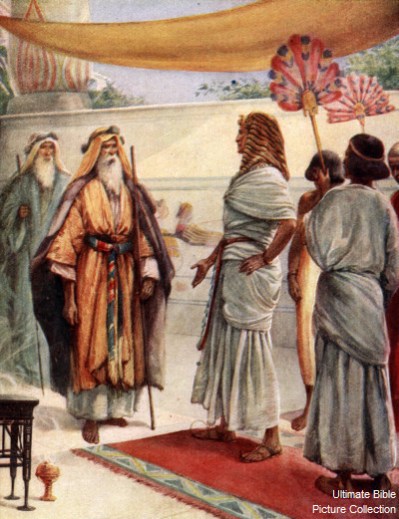
Finally, after years upon years of bitter and long exile, suffering and slavery- Hashem turns to Moshe and tells him, the time for redemption has come: “Moreover, I have heard the groan of the Children of Israel whom Egypt enslaves and I have remembered My covenant,” and he requests of him to pass on the hoped for message to the children of Israel: “Therefore, say to the Children of Israel: ‘I am Hashem, and I shall take you out from under the burdens of Egypt; I shall rescue you from their service; I shall redeem you with an outstretched arm and with great judgments.  I shall take you to Me for a people and I shall be a God to you… I shall bring you to the land about which I raised My hand to give it to Avraham, Yitzchak, and Yaakov.” (Exodus, Chapter 6, Verses 5-8)  These words are so comforting, soft and healing: “My beloved children, it’s me, Hashem, and I promise you that from now on everything will be okay!  Not just okay, everything will be incredible!  The good ending has come, and I’m coming to take you out of this suffering, to save you from the difficult slavery.  I’m coming to redeem you, to take you as the chosen nation for me and to bring you to the promised land!”

Moshe, who was faithful to the command he received, comes to the Jewish people, who were groaning and struggling from the slavery and crying out for salvation, and tells them the good news, which they waited for for so long: “Beloved brothers, I have good news from Hashem!  Here it is!  Hashem who is great, the one who saved our forefather Avraham from the furnace and our forefather Yaakov from Esav and Lavan; Hashem who promised our holy forefathers that we will be a nation for him, Hashem says that it is happening now!  The redemption is at hand!  Your cries reached the throne of glory, and here it is, he is coming to redeem you!  All of this pain and suffering and servitude and humiliation and weakness- will immediately become history!  Soon it will be good!  There won’t be any more slave masters.  There won’t be any more blows.  The blood of babies will not be spilled.  That’s it.  Everything is going to turn into good!”

A speech full of shining hope for a good future, new, different… and how do the Jewish people react?  “So Moshe spoke accordingly to the Children of Israel; but they did not heed Moshe, because of shortness of breath and hard work.” (Exodus, Chapter 6, Verse 9)  The news of the redemption did not even enter into their ears!!!

Why?  Why didn’t they listen to Moshe?  It’s strange!  They were the ones who groaned and screamed to Hashem for him to save them, and then, when Hashem comes and says to them, “Okay, my precious children, you are free”- they don’t ever hear what he says!!!

How can we possibly understand this???

Rebbe Nachman of Breslov says: “’Because of shortness of breath and hard work’- because they were in the aspect of ‘shortness of breath’, because they were small in their level of faith as discussed above, through this a person needs to engage in difficult work and fasts… and there are several aspects of lacking faith, because there are even Tsaddikim who have a lack of faith…” (Likutei Moharan, Torah 86, Part 2)  Rebbe Natan explains: “When he said to me… that because of a lack of faith a person needs difficult work etc., I stood before him incredulous and my thoughts were in wonderment regarding this matter, because it seemed to me that I have a bit of faith, he answered me and said with a little bit of a language of rebuke: If you have faith, you don’t have faith in yourself… and he mentioned immediately the teaching of the Sages: ‘For who is scornful on the day of small things?’ (Zechariah, Chapter 4, Verse 10)  What caused the table[1] of the Tsaddikim to be disdained in the future?  The smallness that was inside of them, that they did not believe in themselves… It can be explained according to this that they did not believe in Hashem that he is good to everyone and they are important and great in Hashem’s eyes… And the general principle which can be understood from his words is that a person needs to have faith in himself that he also beloved in Hashem’s eyes… great and important in his eyes.” (Rebbe Nachman’s Wisdom, Paragraph 140)

It’s true, they screamed and pleaded to Hashem to save them, but when they were answered, and the redemption was knocking on their door- it didn’t enter their hearts because of smallness of faith, and in whom did they not believe?  They did not believe in themselves.

They did not believe that their scream did something, that their prayers had the power to bring the Messiah.  They thought that in order to merit the redemption you need ‘difficult work and fasts.’  They did not believe that they, as they were, from their place and by speaking with Hashem were truly worthy of redemption!  “They did not believe in themselves!”  They did not believe in this simple truth, that they could call out to Hashem and he would answer and love them and shower upon them good.

Therefore, they allowed the news of the redemption to pass by their ears, and they continued to work hard.

What about us today?

Just as then, also today, in the Egypt of today’s generation which still dwells in the blood and tears of the exile of the soul.  It could be that the news of the redemption is already here, truly, in our hands.  It could be that Moshe stands at our side and whispers to us in the ear: “Listen, beloved ones, this whole nightmare already belongs in the history books!  This bad and painful dream is finishing.  Say enough to blows, blood, pursuits, hunger, pain, loss, blame, confusion, lack of certainty, fears, sadness… a turning point has happened in the story, the time of the redemption has come…”  It could be that Moshe stands here, so close to us, telling us in our ears the news of the redemption- and we don’t hear!  We are in the middle of screaming to Hashem, and from so much screaming, we don’t hear how Hashem is saying to us:  “It’s okay, I’m here, you can calm down, I’ve come to save you.  Now.”  Hashem comes to us with all of the good in the world, and we close our hands and don’t take.  We are not prepared to let the redemption enter inside us.

Why?

Because we don’t have faith that we deserve salvation.  We think that we haven’t prayed enough.  For someone like me, poor and not worthy, to merit this great thing that I want, I need to make more of an effort, to work hard, to pray a lot… a little respect to difficult work, to fasts, self-denial, to reading the book of Psalms two thousand times… according to our outlook, in order to merit a salvation, we need to work hard.  How could it be, that I’ll just call out and Hashem will answer me and the redemption will come?!  How?  I don’t deserve it!

This is one of the messages of Rebbe Nachman: precious Jew, you do deserve it!  You don’t need difficult work in order to live!  Everything is very simple:  you scream from so much pain, your prayer goes up to Hashem, Hashem sends you Moshe, and that’s it, you can be redeemed!

Just believe in it…

[1] Their place in the Garden of Eden