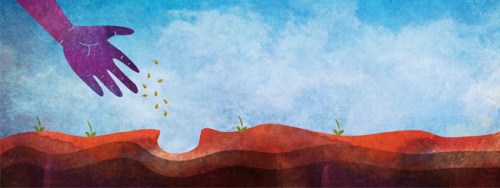
 At the end of this week’s Parsha, which talks mainly about the laws of the Sabbatical year and the Jubilee year, the Torah says: “For the Children of Israel are servants to Me, they are My servants, whom I have taken out of the land of Egypt- I am Hashem, your God.” (Chapter 25, Verse 55)
Regarding this verse, which teaches us both the fact that we are the children of Hashem and that we are his servants, Rebbe Noson discusses how most of the world relates to the concepts of servitude and freedom. For most people eating and drinking and other physical desires are not called work or labor whatsoever. However on the other hand, they call mitzvahs and good deeds work. Meaning that the service of God, mitzvahs and good deeds seem like servitude to them. Rebbe Noson says that this is the aspect of the exchange which Rebbe Nachman tells about in his story, the Exchanged Children, where the son of the maidservant and the son of the king were exchanged at birth. The son of the king grows up not knowing who he really is. People mistakenly think that the body is the king over the soul. However, in truth, the opposite is the case. The true king is our neshama, our soul. Our body was created to serve as a vessel for our soul, and not the opposite. Just as the servant needs to serve his master and do his will, so to our body needs to serve our soul. Rebbe Noson adds that even though it’s praiseworthy to serve Hashem and do His will, despite our struggles with the physical desires of the body nevertheless that is not the greatest level which we can obtain. The highest level a person can obtain is when their body and physical desires become so subdued to the will of their soul, that the body also wants to do only what the neshama wants to do, which is to serve Hashem. This is the highest aspect of being the children of Hashem which we can obtain, that our only will is to do the will of our King. (Likutei Halachot, Laws of the Morning Blessings, 3rd teaching)
How do we return to our true role in life, being the children of the King and making our soul the king over our physicality?
Rebbe Nachman discusses in several places in his book Rebbe Nachman’s Wisdom (Sichot HaRan) our relationship with Hashem as our father. He says that it’s very good when a person can pour out his words before Hashem in supplication, like a son who is longing for their father. (7th teaching) He also describes having a broken heart as someone who is like a son longing for their father, like a small child who is crying because their father went away. (42nd teaching) Being the children of Hashem means that we have an eternal bond of love with Him, and we are truly longing to be close to God.
Rabbi Shlomo Katz, a teacher and musician here in Israel, is giving daily, short video teachings about the special attributes of the Sefirat HaOmer, the special mitzvah of counting the 49 days between Pesach and Shavuot. Each week has a special attribute to it, and each day contains a more detailed aspect of this character trait. This week is the week of נצח, eternity. He says that an aspect of חסד שבנצח, the kindness of eternity, is that Hashem is always there for us. He is eternal and it is a tremendous kindness that we can always turn to Him in prayer. Rebbe Nachman taught his students and anyone who learns his teachings to speak to Hashem every day, in their own words. He gave us the incredible gift of personal prayer. When we make this a part of our lives every day, we begin to re-discover our true connection to Hashem, that we are his children, the children of the King, and He loves each and every one of us like His only child. We merit to develop and re-discover a close relationship with Hashem. We feel his help and protection. We can tell him anything, like a true, good friend (as Rebbe Nachman described personal prayer to his student Reb Noson). We discover the true and eternal love which exists between us, and we begin to feel again like the children of the King. When a child truly feels how much their parents love them and that they only want the best for them, they too in return want to help their parents and do their will. The same is true in our relationship with God. Hashem is pained by our distance from Him, he wants us to be close to Him, just like a parent who is longing to see their child again after a long separation.
We should all merit to know how much Hashem loves us as his children, and we should fulfill the Torah and the mitzvahs with joy, knowing that we are doing the will of our God!
(Inspired by the video of R’ Shlomo Katz mentioned above and a recent class by Rav Erez Moshe Doron)
(The image is courteous of Chabad.org)
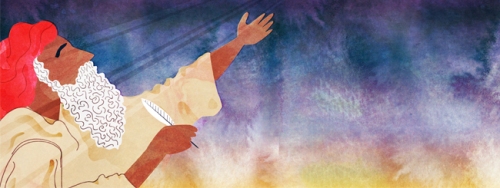 In the second teaching of his book, Likutei Moharan, Rebbe Nachman brings the first verse of this week’s Torah portion at the beginning of his teaching about prayer and redemption. “Hashem said to Moshe: Say to the Kohanim, the sons of Aaron, and tell them: Each of you shall not contaminate himself to a (dead) person among his people…” (Chapter 21, Verse 1) Many times in his teachings Rebbe Nachman brings a verse from the Bible or a teaching from the Sages and then shows you later on in his teaching how everything he just talked about is alluded to in the verse he brought at the beginning. In this verse the word ‘say’, “Say to the Kohanim”, is referring to prayer. Rebbe Nachman teaches in this lesson that the main weapon which a Jewish person has is prayer. All of the battles which they need to conquer, whether they are with the evil inclination or with others who are trying to prevent them from doing something good; all of these battles can (only) be conquered through prayer. Therefore, Rebbe Nachman says that someone who wants to truly merit to reveal the holiness of being a Jew- they need to pray a lot and speak with Hashem. This is the main weapon which they have to win the battle of overcoming the evil forces which try to prevent them from revealing their light. (Likutei Moharan & the Abridged Likutei Moharan, 2nd teaching, Part One)
 “You shall love your fellow as yourself” a well-known commandment, is one of the many mitzvahs between man and his fellow which we learn about in this week’s Torah portion. Before bringing this mitzvah, the Torah also commands us, “You shall not hate your brother in your heart; you shall reprove your fellow and do not bear a sin because of him. You shall not take revenge and you shall not bear a grudge against the members of your people; you shall love your fellow as yourself- I am Hashem.” (Chapter 19, Verses 17-18)
 I wanted to share this week a few short ideas connected to Pesach.
 “Hashem spoke to Moshe saying: This shall be the law of the metzora on the day of his purification: He shall be brought to the Kohen.” (Chapter 14, Verses 1-2) The Sages learned from this verse (תורת המצורע) that even someone who has a type of skin blemish and is considered a metzora, or has a type of bodily fluid emission can learn Torah. Rebbe Noson explains that through the holy Torah which Moshe brought down to us we are eternally connected to Hashem. Even someone who has fallen to a very low and distant place from G-d because of his bad deeds, nevertheless he can easily come closer to Hashem again through learning Torah. The Torah descends even to someone who is in the deepest depths of bad spiritual forces and awakens him and brings him closer to Hashem. Even when a person feels spiritually like he’s lost and dead, even he can hear the voice of the holy Torah. This is the aspect of what the Sages said that the words of the Torah don’t receive impurity. Therefore we learn from this that since the day that the Jewish people received the Torah, there is never anything which can cause us to be permanently distant from G-d. We are always close to Him through the holy Torah which reaches down to the Jewish people wherever they might find themselves. This is the main aspect of the giving of the Torah. Rebbe Noson adds that surely there were great Tzaddikim, like Avraham, Yitzhak and Ya’akov who were able to serve Hashem even before the Torah was given. However, since we received the Torah, its light gives every Jewish person the ability to come closer to Hashem. This is the meaning of what Bilaam said in one of his blessings when he wanted to curse the Jewish people and instead his words came out as a blessing: “How goodly are your tents Ya’akov”, (Bamidbar, Chapter 24, Verse 5). Your tents is a reference to study halls and shuls where people learn Torah. Through the Torah the Jewish people are always connected to Hashem and the power of this connection is also what turned Bilaam’s curse into a blessing. (Likutei Halachot, Laws of Leasing and Contract Work, 2nd teaching)
 “Hashem spoke to Moshe, saying: “Speak to the Children of Israel, saying: When a woman conceives and gives birth to a male, she shall be contaminated for a seven day period, as during the days of her separation infirmity shall she be contaminated.” (Chapter 12, Verses 1-2) After discussing the laws of impurity which result from dead animals at the end of last week’s parsha, the Torah turns to impurity that emanates from human beings and begins with a woman who gives birth (Artscroll commentary there). Rashi quotes a Midrash which says, ‘Rebbe Simlai said that just as the creation of man was after Hashem created the birds and animals, so too the laws of humans are explained after animal life.’
 At the end of this week’s parsha there is a chapter which talks about the laws of kashrut, which types of animals are kosher to eat and which are not. This chapter also discusses which objects become contaminated due to contact with a non-kosher small, creeping animal: “And if its carcass will fall upon any edible seed that has been planted, it remains pure. But if water has been placed upon a seed and then their carcass falls upon it, it is contaminated to you.” (Chapter 11, Verses 37-38)
 “This is the law of the feast peace-offering that one will offer to Hashem: If he shall offer it for a thanksgiving-offering, he shall offer with the feast thanksgiving-offering unleavened loaves mixed with oil, unleavened wafers smeared with oil, and loaves of scalded fine flour mixed with oil.” (Chapter 7, Verses 11-12) Rebbe Noson teaches that the thanksgiving offering is the aspect of the obligation of anyone who is rescued from a difficult situation or sickness to thank Hashem upon their recovery. The four types of situations for which a person needs to give thanks and say a special blessing are: one who travels through a wilderness or desert, one who is freed from prison, a sick person who is healed and someone who travels across the sea (or by airplane today). All of the different types of suffering we experience are the aspect of the exile of Hashem’s presence in the world (גלות השכינה), because in all of our sorrows He also feels the sorrow. His presence is in exile with us. The main expression of the exile is when sadness enters a person’s heart, because all of the negative desires which someone is trapped by happen because of sadness, and as a result of this a person suffers from being far from Hashem, which is exile. Therefore, when Hashem helps somebody be rescued from their difficulty they need to bring a thanksgiving offering. Today, when we are not able to bring this offering, we need to thank Hashem with a full heart, which is the aspect of happiness. The main expression of happiness is when a person thanks Hashem, because this is the main simcha which we will experience in the future, “Give thanks to Hashem with a harp, with a ten-stringed lyre make music to Him.” (Psalms, Chapter 33, Verse 2) It is also written in another chapter of Psalms, “A psalm of thanksgiving, call out to Hashem, all the earth. Serve Hashem with gladness, come before Him with joyous song.” (Chapter 100, Verses 1-2) By thanking Hashem when we come out of a difficult situation, we are able to rectify the sadness which caused us to fall into a state of suffering. When a person lives with happiness, he will be saved from all types of suffering. Therefore, the Sages taught that in the future, when the Temple is re-built, all of the sacrifices will be nullified, except for the thanksgiving offering. (Likutei Halachot, Laws of Thanksgiving, 6th teaching)
 This week we start reading the third book of the Torah, Vayikra, or Leviticus in English. The beginning of this book has several parshas about the laws of offering sacrifices in the Tabernacle and the Holy Temple. What can we learn from these laws today, when we don’t have the Temple and we don’t have sacrifices? Regarding the Mincha offering, the meal offering, the Torah states: “When a person offers a meal-offering to Hashem, his offering shall be of fine flour; he shall pour oil upon it and place frankincense upon it.” (Chapter 2, Verse 1)
 Our Parsha, the concluding one in the book of Exodus, begins with a detailed listing of the amounts of gold, silver, and copper that were contributed for the construction of the Tabernacle (Artscroll commentary). “These are the reckonings of the Tabernacle, the Tabernacle of Testimony, which were reckoned at Moshe’s bidding.” (Chapter 38, Verse 21) The Sages learn from the fact that the Torah repeats the word Tabernacle twice in the verse that it is the same Mishkan (Tabernacle) when it was built and even when it was destroyed. What does that mean? We can connect to the holiness of the Tabernacle and the Temple even when we don’t have them with us. Rebbe Noson says that we learn from this idea that Hashem gave the remedy before the illness. He commanded the Jewish people to build the Tabernacle, which contained all of the holiness of the Holy Temple. Hashem taught Moshe that the Jewish people could draw down the holiness of the future Temple also while they were travelling for forty years in the desolate wilderness. Hashem also gave a remedy for future generations, that even after the Temple would be destroyed, due to our sins, we would have the strength to draw down the holiness of the Temple through our shuls and yeshivas. The synagogue is called a מקדש מעט, a small version of the Temple. The main influence which helps us draw down the lofty holiness of the Temple into our shuls, even while we are in exile, comes from the Tabernacle. Moshe had the spiritual power to channel all of the holiness of the Temple into the Tabernacle, which was a temporary structure to be used by the Jewish people until the building of the Temple in Jerusalem. This was the main aspect of establishing the Tabernacle: to give the nation of Israel the power to bring down the holiness of the Temple into their shuls and learning centers even during the time of exile. (Likutei Halachot, Laws of Chol HaMoed, 4th teaching)
 Neveloff Wellness