Parashat Shemot
Our Spiritual Exile in Egypt
Where do we meet this week’s Torah portion in our lives? In our soul. Rebbe Natan of Breslov says: “all of the exiles are called the exile of Egypt, and the main exile is the exile of the soul.” The exile of the soul. A concept that once we come to recognize it for the first time, we begin to believe that there is also redemption.

Harav Israel Asulin
Translated by Moshe Neveloff
Monday, 16th of Tevet, 5776
BS”D
It is explained in the Chassidic writings that for all of the events which happened in the Torah, there is a parallel experience in our soul. Everything that happened in the Torah- beginning from the creation of the world from the chaos and darkness that preceded it, continuing with the birth of the generations from Adam, the events and journeys in the desert, and concluding with the receiving of the Torah and the entry to the Land of Israel- all of these events happen to every Jew inside his soul.
So too the descent to the Egyptian exile.
“A new king arose over Egypt, who did not know of Yosef…The Egyptians enslaved the Children of Israel with crushing harshness. They embittered their lives with hard work, with mortar and with bricks, and with every labor of the field…” (Exodus, Chapter 1, Verses 8-14) Here begins 210 years of enslavement and harsh labor, decrees and suffering; here the exile begins.
Hey!? What does this have to do with us? We are, thank God, in the Land of Israel and not in Egypt. Pharaoh died a long time ago, and Pitom and Ramses we know of from the Pyramids, not from the slavery…
Correct. The current Egypt is not the Egypt of the Torah, it is the exile of the soul, because “all of the exiles are called the exile of Egypt, and the main exile is the exile of the soul.” (Rebbe Natan of Breslov)
In order to understand what the exile of the soul is, we need to first understand what is exile? Exile refers to a person who is not in his place. He is far from his home, from his land, from his natural place, and not by choice. This is really the definition of the exile of the soul- you are not in your natural place. You are not where you need to be. You are not where you want to be. Distant. A captive in a foreign land.
Of course, you can live in a furnished and designed beautiful apartment, with a large salary, a wife and children and all of the pleasures of the land of Egypt. However, is your soul in its place? Do you find yourself, inside, where you want to be, where it is fitting for you to be?
In truth, our place needs to be filled with love and light and connection and faith and happiness and excitement and honor and unity. That is our true place!
Where do we find ourselves? In loneliness, separation, disconnection, emptiness, depression, fear, lack of trust, lack of meaning, in pain…
Why? How did this happen to us? How did we lose our place? How was love exchanged with alienation, connection with loneliness and trust with suspicion? How where we exiled so much from our good, true, natural place?
Everything began when we were children. We were born as children who loved and felt connected and gave 100 percent of our faith and we had will with nothing blocking it… then Pharaoh came, by each and every one of us he dressed up as a different figure, but for everyone he bothered us, he moved us from our original place, threw us into Egypt, enslaved us, and thus, in the end, we lost our true selves. We learned to lie in order to find favor. We learned to please so that we wouldn’t be hit. We learned to stop wanting- because there was no chance that we would succeed. We learned not to love- because what is love anyways!? We learned to make ourselves small- so that others would not do it for us with more harshness… we withered, disappeared, constricted our abilities to zero, and forgot what we want. In place of the true self who got lost, our external self developed, who represents our exile. Despite the fact that he is called myself, he is a meager self; he is not really me.
This is our exile. The exile of a person from himself. The exile of the soul.
However, we have not been decreed to be slaves forever. The same means which opened the way for the redemption of the Jewish people- with those means each and every Jew, not only can he, rather he is commanded to redeem himself from his own personal Egyptian exile. To break through all of the barriers and to be free.
The first key is identifying the exile. Someone who does not identify that he is in Egypt will never leave there. To identify that the place which I find myself is not my true place, I’m just stuck there. These clothes that I’m wearing are not me, they are just prisoner’s clothes which Pharaoh put me in in his great cruelty. To identify that I’m faking it, I live a lie, I’m trying to please, I’m disguised like some kind of monster, I’m not myself! Why is this the first key? Because “when a person knows in his heart that he has sickness in his soul, after he has this knowledge he can sweeten the situation by way of this knowledge, and that is his healing. What is not the case when he is in hiding… that he doesn’t know he is spiritually sick, then there is no healing for his blow” (The Baal Shem Tov, Keter Shem Tov, paragraph 25)
The second key is: “and the Children of Israel groaned because of the work and they cried out. Their outcry because of the work went up to God.” (Exodus, Chapter 2, Verse 23) After you have identified that you are in exile- cry out to God, request, plead: “Master of the world, see what I’m going through. Suddenly it’s become clear to me that I’m not at all in my place. I thought that this was my home. I thought that this was who I am. Suddenly I reveal that I’m in Egypt, and this image in the mirror is a lowly reflection of who I buried when I was a child. Hashem, I don’t know who I truly am. I don’t know how to leave Egypt. I don’t know. But I know that I can’t do it by myself. There is a scary Pharaoh. There is noise and subjugators and blows. Please, Creator of the world, take me out of here! I don’t want to remain in this place! I want to return to my original and natural place. I want to return to the love and happiness, to the innocence and trust. Save me! Abba! I want to be redeemed!!” When a person cries from the depths of his heart, he also answered: “for if he shall cry out to Me, I shall surely hear his outcry.” (Exodus, Chapter 22, Verse 22)
The third key is Moshe. Also after the Jewish people recognized that they were in Egypt and also after they screamed out to Hashem- they could not take themselves out of Egypt. They needed Moshe Rabbeinu[1], who would be the mediator between them and Pharaoh, who would bring them the word of Hashem, who would lead them, guide them, and pave the way for them to escape the exile… like then also today, and always. In order to leave your exile, you have to walk in the footsteps of the Tsaddik, the healer of the souls, fulfill his advice, believe in him, to lean upon him, to let him show you the way out from your personal Egyptian exile, to be redeemed, and to begin your journey to the land of Israel!
[1] Our teacher
Parashat Vayechi
My Children
What is required of you is only to give trust, to know it is for sure good, to give yourself to the good and have a good influence- without listening to the weakening whispers in your ear of the scientific proofs and statistical facts and astrological forecasts and the numerological guesses and the genetics…
Harav Israel Asulin
Monday, 9th of Tevet, 5776
BS”D
One of the main branches of the evil inclination is called ‘wisdom and investigations.’ This is a branch which looks really good and has a special, high profile- it is important, learned and logical and sees the expected results. It has an archive filled with very thick books- history books filled with deep understandings and science books loaded with evidence and studies; this branch also has advanced equipment for investigating the future- binoculars, telescopes, sophisticated satellites, scientific sensors, facts, forecasts, statistics and probabilities…
Then you come along, a Jew who wants to live according to God’s will, and suddenly you discover that a representative of this branch is on his way to you… the voice of this same wise guy who sees the future sits on the opening of your heart and mind and pokes at you with destructive consistency and logical arguments: “Forget about you! There’s no chance! You already tried to go towards the good and you see with your own eyes how always at this important moment, everything turns upside down to evil and black and unbearable. Why even try?! Look at the reality outside! Look yourself at this darkness and tell me: Where is it possible to find light here? How? What, are you blind!? Please, do me a favor, have both feet on the ground and don’t speak to me with unrealistic and mystical concepts of ‘good’, ‘progress’, and ‘light’, when the reality speaks for itself. Don’t be naïve, look at the reality with a realistic outlook, forget about all these nice words; let’s let life flow as it is, with hope to get hurt as little as possible and to survive as much as possible…”
Yes. The branch of the wisdom and investigations is veteran and professional and knows to work excellently. Not from today, from ancient times.
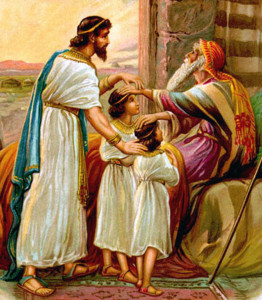
In this week’s Torah portion, Parshat Vayechi, Yosef the Tsaddik comes to his father Ya’akov with his two sons, Menashe and Efraim, who were born to him in Egypt, and he asks Ya’akov to bless them. Ya’akov receives them with happiness, however he immediately sees with prophetic vision that in the future really wicked people will descend from the sons of Yosef: “Then Israel saw Yoseph’s sons and he said, ‘Who are these?’” (Genesis, Chapter 48, Verse 8) ‘Who are these?’ Ya’akov asks Yosef, intending to say as the commentators explain: “Who are these- they are not fitting for blessing?!”
Look, Ya’akov our forefather says, I look with prophetic vision and I’m shocked to reveal what will come from these youths in the future- Yeravam the son of Navat who sinned and caused others to sin, Achav, Yehu; how much evil with come from them in the future! So tell me, who are these?? They are not fitting for blessing! I see this difficult future, and I don’t find in myself the power to shower upon them good and bless them!
In truth, how can someone influence and give and serve Hashem and make progress, when we see such a dark, threatening and lustful horizon!?
Yosef the Tsaddik answers in his tremendous holiness and purity: “They are my sons whom God has given me here” (Verse 9) – Hashem gave me them. They are good. Nothing will change this truth, not even a prophetic vision.
Yosef the Tsaddik teaches us that is forbidden for us to act according to the forecasts of the future, even when you possess the power of prophecy and it is clear to you that the future will be bad (by the way, in our current reality, we do not have prophecy)… you must do what you can right now with purity and simplicity, to do the good which is required of you, to have a good influence without rational considerations and making a smart accounting, because “the main purpose and completion is to serve Hashem with complete innocence, without any wisdom… however in truth the main way to obtain the true purpose is only through faith and fulfilling the mitzvahs practically, to serve Hashem according to the Torah with simplicity and innocence, and through this itself we merit what we can merit…” (Likutei Moharan, second part, Torah 19)
Yes, despite everything you’ve been through and despite everything that seems to you that you’ll go through in the future, despite everything and because of everything- don’t loosen your grip on the good, from your belief in the good, from doing good and having a good influence with no boundary.
What about all of the bad that you see and experience in ‘the reality’?
The reality that you see and experience, is measured by you with minimal, external and sensory vessels which take into account only what is visible and not the internal experience, because this life has to it a tremendous, hidden depth with one simple truth: Hashem is good, and he created the world in order to bestow good. Therefore, it has to be that everything is good, here and now, and it will be better and better also in the future.
It’s true, it is terrible to think that my descendants will be mistaken and led others astray, but don’t focus on how it seems from the outside. At the depth, there is only good, even if in your eyes it seems completely evil. If it is from Hashem- it is good. This is ‘my sons’, with everything that means: they are beloved and good and likeable and worthwhile. “They are my sons whom God has given me here”- ‘He showed him through this that this is God’s will, in this itself is hidden the hidden good.’
What is required of you is only to give trust, to know it is for sure good, to give yourself to the good and have a good influence- without listening to the weakening whispers in your ear of the scientific proofs and statistical facts and astrological forecasts and the numerological guesses and the genetics…
When Ya’akov our forefather sees the complete belief with no hesitation which Yosef has in his sons, even against a proof from Ya’akov’s prophetic vision which seems to be completely bad- immediately Ya’akov is appeased and he says: “Bring them to me, if you please, and I will bless them.” (Verse 9)
Ya’akov did not just bless them, but also if you merit to walk with this innocence, if you merit to strengthen the good in a simple way, without lessons learned from the past and silly considerations of the future, then immediately the abundance will arrive and the blessing will be upon you.
Parashat Vayigash
The depth of Crying
Harav Israel Asulin
Tuesday, 3rd of Tevet, 5776
BS”D
One of the issues we run into it when we merit to make progress in our spiritual growth relates to other people.
After a person engages in personal development work, makes progress and increases his ability to make good choices- suddenly he begins to see the people that were left behind, and he realizes how much they are stuck and lacking direction. If, for example, you merited to stay in the boundaries of healthy eating that you set for yourself and you made it through Hanukah without letting a tiny bit of jelly or powdered sugar touch your lips- what goes through your mind when you see around you plump people who are chewing between their teeth donuts dripping in oil, Kosher L’Mehadrin, according to the method of increasing each time? Or, when your child made you crazy and despite that you succeeded in taking responsibility for your feelings and you believed the internal voice of your mature self: “This is my experience”- what do you think about all those types of people who go crazy in front of their mirror and kick it with no mercy? Or when you danced with great closeness to Hashem and your strengthened yourself in emunah[1] that Hashem is good and everything is for your best, even when you felt difficulty and sorrow- what are you supposed to do when another person is in a lot of pain or sad or shut down or bitter?
Yosef the Tsaddik answers the question for us.
In Parshat Vayeishev we met Yosef, the wondrous Tsaddik who danced in the darkness of Egypt. There he was, alone, lonely, disconnected and distant from his father’s home surrounded by the impurity of Egypt, imprisoned and subjugated in a completely despairing reality; “Hashem was with Joseph, and he became a successful man” (Genesis, Chapter 39, Verse 2)- ‘he was dancing and skipping’, he lifted himself up from his reality and defeated the darkness of Egypt!
On the other hand, the Torah takes the trouble of describing to us the many times that Yosef cries.
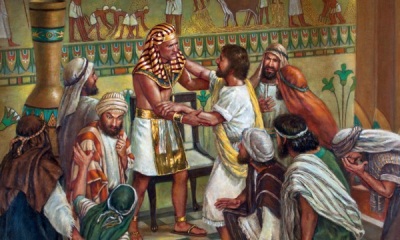
Yosef’s cry when he reveals himself to his brothers still sounds natural and required: “Now Joseph could not restrain himself…He cried in a loud voice.” (Genesis, Chapter 45, Verses 1-2) However, the matter of Yosef’s crying returns and is emphasized many times, and is not always understandable from first glance: When the brothers reached Egypt for the first time, the verse says: “Then they said to one another, ‘Indeed we are guilty’…He turned away from them and wept.” (Genesis, Chapter 42, Verses 21-24) When the brothers returned and came back to Egypt with Binyamin: “Then he lifted up his eyes and saw his brother Benjamin…Then Joseph rushed because his compassion for his brother had been stirred and he wanted to weep; so he went into the room and wept there.” (Genesis, Chapter 43, Verses 29-30) Later on, when he reveals himself to his brothers: “Then he fell upon his brother Benjamin’s neck and wept;” (Chapter 45, Verse 14) “He then kissed all his brothers and wept upon them.” (Chapter 45, Verse 15) Also when Yosef merits to meet his father, Yaakov reads the Shema Yisrael prayer and rather Yosef: “He appeared before him, fell on his neck, and he wept on his neck excessively” (Chapter 46, Verse 29), again he cries. Even when his brothers come to him with the offer to be his servants: “And Joseph wept when they spoke to him” (Chapter 50, Verse 17), they speak and he cries.
It is strange.
Why on earth are you crying so much? About what are you crying? Furthermore, how does this go together with the dancing and skipping?
Behold when you stood, as an alone young man, against the servitude and lowliness and incredible difficulties- you danced, and specifically now, when the story moves toward its good ending and you merit to see you dreams becoming reality- behold, you rule over all the land of Egypt, you have sons and wealth and honor and kingship, and furthermore you merit to reunite with your family after so many years of separation and longing; specifically now you cry so much?! Why? About what?
If we contemplate the verses we can receive from Yosef the Tsaddik, who merited to traverse the challenges and lift himself up to the awesome level of a Tsaddik who is the foundation of the world, exact and inspiring guidance how to look at the other and how to behave with someone else, even when we are already great Tsaddikim who overcome even the donut and take responsibility and hold on to pure faith that everything is for the best…
Yosef’s crying was not crying for himself. It was cries of mercy and participation in the sorrow of somebody else. Cries of giving.
In his darkness he danced, but not in the darkness of others. When someone else was in pain, when his brothers were embarrassed or suffering or hurting or feeling regret or hitting themselves- then Yosef would cry. When mercy for his brother Binyamin overcame him- then he cried. When he met his father who mourned for him many years with endless sorrow- again Yosef cried.
Here he breaks out dancing to a song of faith that everything is for the best… and here he can’t restrain himself from crying so much! He cries and cries and cries again and can’t restrain himself from crying in front of his brothers!
Yosef learned this exalted crying from his mother and ours, Rachel, whose whole essence was crying for the other, a cry of giving which gave birth to the promise of redemption: “Thus said Hashem: Restrain your voice from weeping and your eyes from tears; for there is reward for your accomplishment…and your children will return to their border” (Jeremiah, Chapter 31, Verses 15-16), concerning this crying the Midrash says: “Just as Joseph only appeased his brothers through crying, so to Hashem only redeems the Jewish people through crying.” (Midrash Rabah Vayigash 93, 12)
To cry a cry of giving is a tremendous virtue, this is the goal, and in the end the path to the redemption.
[1] Faith
Parashat Vayeishev
Me and My Clothing

Harav Israel Asulin
Monday, 18th of Kislev, 5776
BS”D
It is written in this week’s Torah portion, regarding Yosef and the wife of Potifar: “She caught hold of him by his garment, saying ‘Lie with me!’ But he left his garment in her hand, and he fled, and went outside.” (Geneis, Chapter 39, Verse 12)
Rebbe Nachman says (Rebbe Nachman’s Wisdom, paragraph 100): “The evil inclination catches a person with his clothing, that is to say that he bothers him regarding his clothing. Because a person’s worry about the need for clothing greatly confuses him and prevents him through this from serving Hashem. This is what it means ‘She caught hold of him by his garment’. However, someone who has a strong soul and his heart is strong in serving Hashem doesn’t pay attention at all to this matter, and this is what it means ‘But he left his garment in her hand, and fled’- he leaves his clothing and escapes from them and doesn’t pay attention to them whatsoever, he just does what he can in his service of Hashem.”
Rebbe Nachman reveals to us that the evil inclination has an amazing trick for trapping someone- clothing. His fishing rod automatically zones in on clothing; that is his method. He spreads out before us a net, catches us with clothing, and keeps us by him, far from the service of Hashem.
What is clothing?
Clothing is not specifically the clothes that we buy in the store and wear on our body; clothing is anything that we put upon ourselves from the outside, it is our external image. Just as there are different types of clothing, for every time and season, so to the external image takes many different ways of talking and interacting.
In truth, there is no doubt that there is a role for the external image. This image is what allows a person to conduct himself in the world and have a place amongst people. A person places upon himself an image as a need, as a defense. Sometimes it is the only way it seems to him to conduct himself in the world. The feeling is that if it were not for the external image, a person simply could not survive.
However, when we make the less important, the clothing, the main thing, when somebody identifies so much with his external image until he has no differentiation and it seems to him that he is the external image and that he can’t get along in any other way from that which he is used to, this has gone beyond a ‘need’ and become something troubling. A bother which holds up our service of Hashem.
***
It’s a bit difficult to understand, what is so bad about identifying with my external image? It’s a sin? What is the connection between the external image and the evil inclination? In general, how can these external images and ways of being prevent us from serving Hashem? The external image that a person gives himself limits him and bounds him. It tells him how to behave and what to feel, where all the other variety of possibilities which are not part of the same fixed way of acting are not in the picture. When somebody allows a certain way of acting to take over his choice, he is by definition limited and able to realize just a small amount of his talents and attributes.
The inability to change ways of acting is exactly what stops a person from growing. Rebbe Nachman says that “She caught hold of him by his garment” is the evil inclination which whispers to a person: “You are not able to!” “This is the only way that you know and therefore it is the only possibility!” In this way he catches the person by his external image and prevents him from moving in the right direction.
Someone who recognizes his true value, his talents, the holiness of his limitless soul, does not worry about his clothing- his external image, he identifies what is more important and what is less and he clings to the main thing- even if the meaning of this is leaving behind his habits and disconnecting from everything known and certain.
A person like this agrees to leave his clothing and escape without it, “even though he doesn’t have another piece of clothing to wear, nevertheless he doesn’t concern himself with this and he doesn’t want to let himself be confused by this!”
If you will forego your clothing/ external image, if you agree to dedicate yourself completely to the good and release yourself from holding on to these external things, you will merit God willing to the continuation of verse regarding Yosef: “And (he) went outside”- away from all the imaginary chains which hide you from yourself. Away from all the threatening barriers which stop you and prevent you from realizing your true purpose in serving Hashem and in the world.
Go forward to the real life.
Parashat Vayishlach
Everything or nothing?!

Harav Israel Asulin
Monday, 11th of Kislev, 5776
BS”D
“Yeah, I already tried, I already worked on this point, but I didn’t succeed. It’s too much for me, and that’s it.”
This is a sentence that we hear a lot from many people and in many variations, where the common message of all of them is: “Listen, I tried- it didn’t work for me, so leave me alone.”
One of the stronger tendencies in our soul is the tendency towards everything or nothing. This tendency raises its head with more strength and intensity when we try to enter the service of Hashem, work on ourselves and connect to our inner self.
Also here we want to be successful. We want to serve Hashem in a complete way, to do everything and exactly the way that Hashem wants from us. To have a hour a day of personal prayer with a broken heart and supplications, and to be happy and joyful the remaining twenty three hours… to be successful in Torah learning, fulfill the mitzvahs with beauty, to finally be weaned and overcome all addictions, to be an amazing husband- a good listener, accepting, understanding, and a good father and educator…
In short, to be complete.
This is good and correct, to want to reach all of the true spiritual good.
The problem begins when our will meets the evil inclination and all of his soldiers, and the accomplishments become distant from us, and nothing goes our way, and we scream at our children instead of hugging them and we eat donuts instead of cucumbers and we don’t succeed in weaning ourselves like we hoped and we don’t pray like we wanted to and we’re not able to learn like we dreamed.
If also then we continue to hold the flag of “everything or nothing” and the “everything” gets buried, then what we are left with is the despair of “nothing”. This is the sentence that says “listen, I tried- it didn’t work for me, so leave me alone.”
In this week’s Torah portion Rebbe Nachman speaks in an incredible way exactly about this matter.
It is written: “Then Jacob sent angels ahead of him to Esau his brother to the land of Seir, the field of Edom…The angels returned to Jacob, saying, ‘We came to your brother, to Esau; moreover, he is heading towards you, and four hundred men are with him. Jacob became very frightened, and it distressed him. So he divided the people with him, and the flocks, cattle, and camels, into two camps. For he said, ‘If Esau comes to the one camp and strikes it down, then the remaining camp shall survive.’” (Genesis, Chapter 32)
When Esav and his soldiers came close to Yaakov’s camp, and the threat was great and tangible, Yaakov divided his camp into two camps. What is the reason for this division? “Then the remaining camp shall survive.” If, God forbid, he is not able to save everyone, at least he can save some of them.
Rebbe Natan explains: “When we see that it is difficult to obtain the complete advice, we need to behave according to part of the advice in any case, in a way that the remaining camp shall survive and not be completely lost, God forbid. That is to say that when a person sees that the evil inclination overcomes him and it seems to him that he doesn’t have the strength to stand up to him as he needs to, and whatever advice and plan he thinks of does not succeed as he wants, he should behave according to part of the advice, which is the aspect of ‘he divided the people with him… then the remaining camp shall survive.’
This means that a person should establish in his heart that no matter what, nevertheless I’m remaining strong so that I won’t fall backwards completely from Hashem and I will never cause myself to despair, and I will make an effort with all my strength to grab some good every day of my life; and if, God forbid, I can’t pray at all, I’ll see to it to speak afterwards some words of request and supplication, and if I will be prevented also from this God forbid, I’ll scream in any case- ‘Master of the world please save me’, and so forth.” (Likutei Halachot[1], Rosh Chodesh, 7th halacha, paragraph 52)
Listen- Rebbe Nachman and Rebbe Natan say- I understand your tendency to choose ‘nothing’ when you don’t succeed in touching ‘everything’. Understand, here is exactly your work! Be okay with the fact that you are not perfect and cannot do everything. Be okay with the fact that not everything is in your hands. Agree to do just half of everything you dreamed about. Do what you can. Grab something. Don’t give up, God forbid, on everything.
You can’t pray? Say a few words.
You can’t get out even a word? Scream!
You are running to the bakery to fill all of the empty batteries from the last few months of detoxification? You’re not able to overcome? Okay, but keep something small for yourself. At least the willpower, at least the right direction. Don’t fall apart, hold on to your clarity as you face the croissants.
Don’t choose to become despaired.
Understand, God has pleasure from your work even when it is partial. He loves you also when you succeed one day and fail the next. He is happy with you, also when you try and don’t succeed, and you choose to continue and begin anew.
On the contrary, in Heaven they love specifically this struggle, your courageous falling and getting up, your effort to grab onto something when it is impossible to do everything perfectly, your tremendous courage to forego the flag of ‘everything or nothing’ in exchange for true nullification to God’s will.
This is the most exact service of Hashem; I don’t serve myself and the dreams of heights or depths which the evil inclination sketches for me with an artist’s hand. I’m not supposed to supply a certain amount of goods according to the plans and the planners…
I serve Hashem, as He wants- at the pace and the time and in the way that he dictates; not the plans, not the output, and mainly- not myself.
[1] Rebbe Natan’s explanation of the Code of Jewish law, based upon the teachings of Rebbe Nachman
The Inner Child
Once there was a child. A child who was happy, innocent, spontaneous and full of life. A child for whom the long arm of ‘physical appearances’ had not yet reached him, and his soul was still clean and free from all of th e social norms.
HaRav Israel Asulin
Once there was a child. A child who was happy, innocent, spontaneous and full of life. A child for whom the long arm of ‘physical appearances’ had not yet reached him, and his soul was still clean and free from all of the social norms and external requirements which program the individual how to live.
He was a special creation with no masks.
He was free from the human demand to show at any given moment a different face, to don a smile when requested or a mature and understanding expression or a serious and important face or a listening and attentive face or a cute face or a learned expression…
He was free from all of these things. Free from all obligations or dictations to smile or be serious, to spread a smile across his face or to just smile with his eyes, to speak quickly or to leave the words inside…
Once there was a child and he was real, this child. It’s not a song or a story, this is me and you; this child who walked with spontaneity and satisfaction under the stars above, and he was the same as the way he felt in his heart. He smiled and laughed when he was happy. He cried when he wanted to cry, and shed tears when they came to him. He wanted everything that he felt a desire for, and he was not influenced by all of the demands which stop a person so much from being.
However here, as we all know, a sad change happened in the story.
The child grew up and the masks of life changed their form and color. Blue masks, clean and pure which only contain a young child and his pure desires, were exchanged for multi-color masks, loud and bold, which flicker upon them many different large and demanding personalities; parents, friends, relatives and teachers. All types of giant figures pinching your cheek, sometimes with angry expressions, and always expressing different types of “hey” while waving a raised, firm finger; a discouraging and reprimanding “Hey, hey, hey”, or a demanding and lacking patience “Hey!”, or a piercing “Hey!!”, or a “Hey” which is diminishing.
There, like a dwarf at the feet all those giants and their demands, something changes in our child. New rules take control of his life, pulling him out of the Garden of Eden of innocence. Rules which say ‘give and take’ or ‘don’t be different or just be like this’… ‘God help you if you’ll escape or forget!!’
The child stares at the changing screens, and slowly internalizes that the game of life is changing and he goes from a life of true fun to a state of emergency of survival in a monstrous situation.
Suddenly they don’t just love him because that is him and he is so sweet; suddenly in order to merit some love he needs to stand up to a heavy list of tasks. Suddenly they are not amazed at him the way he is, because he’s so special… in contrast, they reprimand him for who he is and require him to change to fit into the molds and he has no clarity if he wants to keep living…
So what if the molds are greater than his strength and abilities? – He should stretch himself and fit into their measurements! What if the mold is constricting to his spirit and will? He should constrict himself and choke himself into it…
There’s nothing that can be done, that’s life. The exterior reality demands of a person to put on a show non-stop. Somebody needs to always set up a display window which is fitting and proper, even if the ‘inside’ is completely different.
***
Thus each and every one of us became two, the ‘true self’ and the ‘external self’.
The external self took the place of the child, took control of him, distanced him from existing, blocked him from expressing himself, guarding all of his strengths and talents that God forbid he should not be revealed and cause embarrassment…
With every additional harnessing of the external self for the social dictates, the true self was pushed more inside, to more hidden and secretive depths. In the end he was buried in hidden depths, like a bottle of pure oil which accumulates its light and hides it in the darkness.
The years passed by, we grew up and became teenagers and afterwards adults and then elderly. However inside, below all of the layers, the child remained.
The child is a child. Thus, as he is, pure, full of innocence and vitality and desires. He is sobbing in a small and cruel dungeon, there they pushed him with no mercy. He is restricted in the darkness. Dried out, hungry and thirsty. Crying with no words about the long years of ‘being what I am not’. Living according to what is considered ‘yes’ in the eyes of others. Yearning for the moment when he will return to shine his light. Desiring to return and to be himself.
***
Has it ever happened to you that you melted in front of a pure and charming child who set his eyes upon you? Immediately you wondered about yourself- what just happened to me?! You are used to being stiff and distant. This is not fitting for you, to sigh with warmth at the cheek of some child, and gently caress in wonderment…
What’s happening to you? Why is your soul coming out all of a sudden?
You soul is revealed from within.
Suddenly, for a moment, the reflection of your inner child is revealed and your spine tingles, burning inside of you the same pure truth of truths.
Like a Jew in captivity who suddenly sees Jewish faces peeking in from the other side of the bars, the will is awakened inside of him to be free. Just the same way the child inside of you shakes in his dungeon, when suddenly the face of a gentle and pure child appears in front of his small window, reflecting himself like a clear reflection.
Because the child who causes you to melt so much, only comes to awaken inside of you your small child. Your reality. The purity of your true good point. It’s not the child that you see on the outside, the son or the grandson or the nephew or the neighbor; it’s the inner child knocking on the walls of your heart, pleading for life.
And you, the grown up- who serves everyone except for yourself- lift your eyes onwards, to the child outside. You smile to him and enjoy his sweetness. You don’t know that inside you have a soft and delicate child, waiting to cry from within you his cry. To smile from within you his smile. To pour out from your eyes his tears. To be silent through you his silence. To say from your mouth his words. To do his actions with your hands…
He is good, the true you, and he is a Jew, and clean and pure and sweet and fitting and beautiful and noble and beloved.
Just return to him already.
***
“Seventy names God called the Jewish people… he is called a youth as it says ‘Israel is a youth and His love’. He is called gentle as it is written ‘I was a son to my father, gentle and singular before my mother.’ He is called a child as it is written ‘a child of delights’. They are called straight because they walk with a straight heart in the ways of God. They are called innocent as it says ‘and the wholehearted will remain in it.’” (Midrash Shir Hashirim)
There is no need to look outside, to yearn for what does not exist or what cannot be obtained; everything is inside of you!
All that you need is to understand that you have inside a child and he is the true part of you. He is actually the most ‘you’. Even though you tried to deny his existence and to silence his voice, he was always there, screaming in anger about his stolen freedom. Waiting for you to return to him and redeem him from being ignored and trampled for so many years. Waiting for you to remove the handcuffs which restrain him and to bring him to freedom.
Just as in the Holy of Holies[1], above the Ark of the Covenant, there were the two faces of the Cherub, faces of children. So to in the Temple inside of every Jew, in the holiness of every soul and every home, there are the faces of pure cherubs, the faces of children!
When you’ll understand that you have a child like this inside, you will then want to reveal him anew.
The essence of a child is the foundation of hope and renewal. “Child” means constant rebirth. Invigorated renewal moment after moment. Every single moment is new, natural and fresh. “I will be born” is referring to the future. “Child” means giving birth in the present. Always new. A reality that does not get old, rather it is renewed constantly.
“The child is poor and wise, this alludes to the Tsaddik- who sustains himself with a little bit. A child, he is in his own eyes as if he is still a child.” (Avodat Yisrael, Pirkei Avot Chapter 4) “Rebbe Simcha Bunim of Psischa would say, according to the verse ‘Better is a poor but wise youth than an old and foolish king’ (Ecclesiates 4:13) – that the main thing is for a person to be new all the time. Because for this reason the evil inclination is called an ‘old king’- because he makes everything old. The good inclination is called a poor child- because he is a child and renews every day like something new. The good inclination is also called poor- as a sign of submission, and from this comes the happiness and renewal.” (Siach Sarfei Kodesh[2], first part, paragraph 186)
Once, when you were small and scared, you gave up on the child. You thought there was no need for him and you put him into the cellar of rejection and denial. However, today you understand that in those same cellars you also imprisoned yourself- your curiousness and your renewal, the creativity and the vigor, the humility and the simplicity, the innocence, the trust and the vitality itself.
Today you want to return to your child. To be friends with yourself, with your spirituality. Today you agree to receive the child the way he is, with the embarrassing things he does and with the desires that he wants; and if you will be wise to return to the child, then you will finally find in your life the pure joy of life, the happiness of a child.
You are an adult, but live your blessed adult life with the child inside of you. Live your life, child inside, be who you are. Go already towards your part of the Torah, whatever that may be, however, it should be yours. Fulfill the commandents of God according to your natural feeling. Don’t be embarrassed and shut down. Don’t be afraid, you’re right. Don’t be suspicious. Cry when you feel pain. Laugh when you are happy. Experience what you are going through, give it words and say them. Sing the song that your heart is singing. A simple song, which never ends, which expresses the sound which wants to say: ‘It is never too late, it is never closed.’ Breathe your precious breath- the candle of Hashem, the soul of a man.
Zechariah the prophet already prophesized about the days of the future redemption (Chapter 8): “Thus said Hashem, Master of Legions: Old men and old women will once again sit in the streets of Jerusalem, each with his staff in his hand because of advanced age; and the streets of the city will be filled with boys and girls playing in its streets.” It will come a day like this of deep redemption, a day when elderly men and women sitting in the streets of the holy city of Jerusalem, will also be like young boys and girls playing! The child in them won’t be thrown and chained in dark basements. They will live their lives with renewal and vitality, with eternal clinging to their true internal roots. The child in them stands up and lives.
Be ready. Exact. Truthful. Real. Be open. Be a child, like this, simply… strive to get there.
[1] The internal chamber in the Holy Temple in Jerusalem
[2] A collection of Breslov teachings and stories
Parashat Chayei Sarah
To Grow from Within the Dirt
There is a light of holiness in the world, and this light is with me and I am with it. There is a gate to the Garden of Eden, a gate to loving God, a gate to an alive and burning connection with the Tsaddik, to the sweetness of the Torah and mitzvahs, and the pleasantness of Shabbat… and this gate is not in Heaven; this is a gate which opens inside my heart.

Harav Israel Asulin
Monday, 20th of MarCheshvan, 5776
BS”D
There is a light of holiness in the world, and this light is with me and I am with it.
There is a gate to the Garden of Eden, a gate to loving God, a gate to an alive and burning connection with the Tsaddik, to the sweetness of the Torah and mitzvahs, and the pleasantness of Shabbat… and this gate is not in Heaven; this is a gate which opens inside my heart.
Until now this sounds really great and even convincing.
However, when a person begins to enter the service of Hashem he is hit with great confusion and pain: Why don’t I feel it? Where is the holiness I was told about? And what is the Garden of Eden? And why do I only see darkness?? Why don’t I feel the pleasantness of the Torah? Why don’t I have sweetness fulfilling the mitzvahs? Why is my Shabbat so dull? Why doesn’t my heart open in prayer? Why don’t I feel anything?
Who said that we feel and connect and ascend and come closer? Who invented these things? Look, I tried, I worked hard learning Torah, I was careful fulfilling the mitzvahs, I honored the Shabbat, I dedicated time to praying from the heart, I gave from my wealth and my strength and I travelled to the Tsaddik[1]… and not only do I not feel anything, I feel disconnected, dense, bored, and like I don’t belong. Maybe it is all for no reason and incorrect? Maybe this whole matter is not for me? It’s dark for me!
Rebbe Nachman teaches us (Likutei Moharan I, Torah 17, second paragraph): “And just as we found regarding Efron[2], that although the Cave of the Patriarchs is the gate to the Garden of Eden from where all the souls ascend and its light is very great, nevertheless for him it was a place of darkness, and therefore he sold it with great happiness to Avraham.”
Yes, Rebbe Nachman teaches us that there is such a thing as a great light which is experienced as complete darkness. However, the light is the reality and the darkness is only an experience, experiencing ‘Efron’. Inside every one of us there exists a small and evil ‘Efron’ who overtakes us and makes our experiences dark, and he convinces us that that is the truth.
Who is this Efron?
“Efron is the aspect of the evil which is grasping on to the element of the dirt, which is the aspect of sadness and laziness and heaviness which come from the evil in the element of dirt.” (Likutei Halachot[3] , Laws of Tefilin, 5, paragraph 40)
In the element of dirt there is evil, and it is the inclination towards laziness and sadness, sinking into the dulling of the senses. When the holiness is found in the hands of ‘Efron” it is covered with the dirt and dust of disconnection, dullness and emptiness. Then I feel the light as a great darkness and the sweet as bitter.
However the reality is completely different. Just as in the Cave of the Patriarchs, also inside of me there is a great light shining, the gates of the Garden of Eden are open. In order to merit this reality, I need to redeem the holiness from its terrible imprisonment by the hands of Efron, to remove from it the layers of dirt and mud and to clean it off.
How do we do this?
Rebbe Natan reveals to us: “Its submission is through the element of dirt from the side of holiness, which is the aspect of Emunah[4]. Through emunah, the aspect of holy dirt, we receive and bring upon ourselves all of the vitality and all of the holiness and we merit the aspect of the power of growth and flourishing, and we blossom in His service. Therefore, Avraham acquired the Cave of the Patriarchs from Efron specifically.” (ibid)
When I awaken the good that is in the dirt- I can subdue the evil which is in the dirt. Holy dirt is the foundation of emunah and submission- “and my soul will be like dust to all[5].”
Believing means that I don’t battle the feeling of emptiness and I’m not scared by the light being hidden; I simply believe in the Tsaddikim that tell me that that is not the reality, rather only a test. I believe that it’s not me who is distant from the holiness, rather it’s ‘Efron’ who is blurring the true picture.
Most importantly, I believe that underneath this blurriness I have a great heart that can contain everything- love and awe of God, exaltation and excitement from any aspect of holiness.
If I want to redeem my holiness from Efron, and if I want to strengthen my faith and the aspect of the holy dirt, then I will merit to reveal that also what seems to me dry and meaningless, foreign and distant, is actually alive and refreshing, necessary and close, beloved, known and shining. Specifically from the dirt I grow and ascend the mountain of Hashem.
[1] Rebbe Nachman of Breslov
[2] The non-Jew from whom Avraham bought the land in Hebron to bury Sarah
[3] Rebbe Natan’s explanation of the Code of Jewish law, based upon the teachings of Rebbe Nachman
[4] Faith
[5] From the daily prayers
Parashat Vayeira
I’m Tired of Waiting
We speak a lot about personal development; about working on boundaries, about building a connection- with Hashem, with the Tsaddik, with myself and with my spouse, and about the journey to the complete and true good. We want to get there. That is the goal of each and every one of us from the place he finds himself and which he is dealing with, to go towards the good and the holiness.

Harav Israel Asulin
Tuesday, 14th of MarCheshvan, 5776
BS”D
We speak a lot about personal development; about working on boundaries, about building a connection- with Hashem, with the Tsaddik, with myself and with my spouse, and about the journey to the complete and true good. We want to get there. That is the goal of each and every one of us from the place he finds himself and which he is dealing with, to go towards the good and the holiness.
Then you come, with all of the willpower and faith, and begin working. You receive upon yourself a set amount of time of personal prayer and make clear boundaries with food and weaning yourself from addictions, and you connect to the Tsaddik and to a friend… and you expect that things will open for you, that you’ll feel something, that you’ll become a tsaddik, that you’ll lose weight, that the gates of the Garden of Eden will open for you…something. You give so much in order to find Hashem, what, they won’t give you something in return?
Sometimes we do everything and feel they are leaving us behind the door and not allowing us to enter. As much as we knock and request politely and with tears and with pleas and desire, the feeling is that everything remains locked with a stubborn and clear sign of “no entry”. This causes despair.
How much can you continue with personal prayer, for example, to dedicate a significant amount of time from your busy schedule to speak with Hashem, and to find yourself, again and again, feeling dry, empty and distant, as if Hashem cannot be found? How much can you try your hardest to learn the holy Torah and feel that your brain remains dense and blocked? How much can you dedicate yourself to stay within the boundaries of healthy eating and see the same annoying digital numbers on the scale, as if you didn’t do anything? Or invest yourself in coming closer to your spouse, just to run into the same walls…? How much?
It’s difficult, and therefor people give up and retreat.
However, there is a very simple foundational point, that if we would remember it, it would be much easier for us in this battle. This fundamental point says that that’s the way it is. It is impossible to enter into holiness in one instant. It takes time. “It is necessary for a person to wait until he merits a full rectification. It is impossible to enter into the holiness in one moment.” (Abridged Likutei Moharan[1], Torah 6, 4th paragraph)
It’s not that you were supposed to reach the goal and you didn’t get there; that is simply how it works, that it takes time to get there.
When you find yourself behind a closed door and it seems to you that you’ll never reach the expected good and that everything you waited for is in vain, God forbid; what is required of you now is simply to wait- don’t give up. Don’t let go of the will. Don’t give in to the temptations which overtake you specifically now with more intensity and attack you from all directions: maybe we’ll look for happiness in a different place and not in the world of holiness? Maybe we’ll make do with an imaginary good? Maybe we’ll ease ourselves into the warmth of unnecessary materialism? Maybe we’ll go back to sleeping an eternal sleep of nothingness?
Don’t concede. Remain in your place and wait until the door opens for you, and it will open.
In this week’s Torah portion we see how much Avraham waited until Hashem revealed himself to him. Rebbe Natan writes in Likutei Halachot[2] (Laws of Marriage 4, 19th paragraph): “’While he was sitting at the entrance of the tent in the heat of the day’ (Bereshit, Chapter 18, Verse 1) – the word sitting here is the language of being delayed for a long time, that is to say that he merited God’s revelation by sitting many days by the entrance of the tent, which is the entrance to holiness.”
Avraham our forefather did not despair. He sat at the entrance to the tent, the entrance to the holiness, expecting for such a long time and nothing happened; not only was he not allowed to enter, even more than that, Hashem removed the sun from its covering, “in the heat of the day” is the aspect of the heating up of the evil inclination, which increases mainly when someone is close to the entrance to holiness.
Despite the time which went by and despite the heat, Avraham our forefather did not give up. He understood that there is no reason to search for happiness in any other place. Except for what we have done to come closer to Hashem- nothing will remain.
Just as Rebbe Natan says so beautifully in Likutei Halachot (ibid): “Someone who does not want to fool himself and thinks about his ultimate purpose truthfully, he doesn’t retreat in any way in the world however things might be, he just sits and waits and stays by the entrance many days however long it takes; and even though they don’t allow him to enter into the opening and the heat of the day really burns him, nevertheless he doesn’t let go and he sits and remains by the entrance of the tent of the Tsaddikim, until God will have mercy on him from Heaven.”
It’s important that we know that the time of waiting is not a time that goes by for no reason, as it seems to us. This time is exactly the time needed in order to build the proper vessels to hold the abundance which is waiting for us. During this time we build submission and faith. During this time we clarify our will, free ourselves from holding onto control and receive upon ourselves the yoke of Heaven.
The very fact that we agree to wait changes us. We give over the leadership to the hands of Heaven, and clean ourselves of arrogance and control.
Just like the expectation for a seed to sprout or for a fruit to become ripe, a person needs to change the impatience to contemplation, agreeing to allow the process of growth and formation to take place.
When we contemplate we merit to see how many salvations we have already received, and how many expansions Hashem, who is good, has already expanded for us. Through this we receive the strength to continue and wait, until Hashem will gaze down and see from Heaven.
Rebbe Natan writes to his son: “You see with your eyes the truth of the words we have spoken a lot in these times how we just need to wait for Hashem’s salvation. We see God’s salvation every day and all the time. Also regarding the building of the synagogue (he is referring to when they built the synagogue in Uman) I see Hashem’s salvation every day, however nevertheless we need to always wait with everything in general and in specific matters, and the main thing is to know that the main salvation is to merit to truly come close to the service of Hashem. I myself in my modesty have waited a great amount, and our eyes are longing all day to His true salvations. I have already seen Hashem’s salvation many times, however nevertheless in the matters where I still have not been rescued I’m still waiting, until Hashem will gaze down and see from Heaven.” (The letters of Rebbe Natan, letter 23)
Every moment that we sit, like Avraham our forefather, by the entrance, waiting with acceptance, we are changed.
Every moment that we continue to hope, we don’t despair and we don’t concede, we are purified and we make progress.
In the end Hashem always saves us!
[1] The main collection of Rebbe Nachman’s teachings
[2] Rebbe Natan’s explanation of the Code of Jewish law, based upon the teachings of Rebbe Nachman
Two Nutrition Articles Published!
I hope Bubby is proud of me! It is in her merit that I went into the nutrition field. May her neshama have an aliyah today on her 7th yerzheit. L’aluie nishmat Tzriel bat Ben Tzion.
 Neveloff Wellness