Parshat Chayei Sarah 5779
 “Sarah’s lifetime was one hundred years, twenty years, and seven years; the years of Sarah’s life.” (Chapter 23, Verse 1) Rashi explains, based on the Midrash Raba, why the verse repeats the years of her life separately, and doesn’t just say her lifetime was one hundred and twenty seven years. Each number comes to teach us something special: at one hundred she was as sinless as a twenty year old (until the age of twenty someone is not liable for punishment), and at twenty years old she had the natural beauty of a seven year old, who does not need cosmetics. Rashi adds that the years of Sarah’s life were all equally good (Artscroll commentary). What do the years of Sarah’s life come to teach us today in our lives? How do I feel, old or young?
Rebbe Noson explains that the years of Sarah’s life come to teach us that the main aspect of completion which a person can obtain is beginning to live anew each time. What does this mean? Even when you grow old and become elderly, you should look at yourself as if you are still a very young child, as if you still haven’t started to truly live and serve G-d whatsoever. This will help you to begin now a life of meaning serving Hashem with new strength every time. If a person looks at himself like he’s still young this will help him grow spiritually and merit a long life. His days will be truly long because he doesn’t allow any day to pass by without adding holiness and vitality. (Likutei Halachot, Laws of Tefilin, 5th teaching) We too can live a full life like Sarah, and it depends upon our perspective. Feeling young or old depends on how we view ourselves and how we approach life.
Rebbe Noson also brings in the same teaching mentioned above Rebbe Nachman’s story about the Seven Beggars, who were not actually beggars but great Tzaddikim, each of whom possessed a special trait which seemed on the surface as a deficiency. Each of them comes to visit a bride and her groom during the seven days of special meals following the wedding (called Sheva Berachos in Hebrew). On the first day, the blind beggar came to visit them. As he was speaking to them he said, “I am extremely old, but I am completely young.” In his commentary Rabbi Aryeh Kaplan, of blessed memory, explains: “Since one is always making a new beginning, it is as if one’s life were just starting.” Therefore in the Torah there are several verses which speak of fulfilling the commandments today, meaning that we should learn and fulfill the Torah as if today was our first day. Rabbi Kaplan concludes there, based on the Likutei Halachot, “Thus, we can learn from the blind beggar the power of this continuous renewal. One must be blind when it comes to looking at obstacles in one’s path to serving G-d.” (Rebbe Nachman’s Stories, Breslov Research Institute)
Personally, this teaching about the life of Sarah encourages and helps me to look at myself as still young, even though I see myself getting older physically. I am learning with students at the yeshiva I teach at who were born when I was 21 years old (!), and I have the thought occasionally, ‘wow, I feel old.’ I turned 40 years old two months ago, and sometimes when I look in the mirror and see signs of aging, like more white hairs in my beard and hair, it is hard for me to accept. Hey, how did so much time go by! However, I see that trying to live a life of serving Hashem the best I can, a life of giving, learning and adding whatever good I can in the world helps me many times feel young and alive inside.
Video 4
We finally got our own caravan! Thank you for your donations! May this Shul be a place of unity!
Parshat Vayera 5779
 This was honestly the first time since starting to write a weekly teaching about the Parsha that I didn’t know what to write about. I had a few ideas, but I couldn’t think of what I wanted to say about them. Then, after reviewing a parsha article which I translated a few years ago, I was reminded of some important qualities we learn from Avraham at the beginning of the parsha which can help us greatly in our lives- determination and patience. “Hashem appeared to him in the plains of Mamre while he was sitting at the entrance of the tent in the heat of the day.” (Chapter 18, Verse 1) On the third day after his circumcision, when the wound is most painful, G-d came to visit Avraham. To spare Avraham the physical stress of hosting guests at this difficult time, He created a strong heat wave which prevented people from travelling that day. Still, Avraham sat by the entrance of his tent longing for guests. (Artscroll commentary there)
Based on this verse, Rebbe Noson teaches that the language of sitting means being delayed for a long time. Avraham merited Hashem’s revelation because he sat and waited for a long time by the tent’s opening, which is the entrance to holiness. His whole life, since he was a small child, he was searching for truth and closeness to G-d. He was determined to serve Hashem despite the heat, despite being prevented and attacked by the evil inclination, and despite facing strong obstacles. Avraham was willing to wait for as long as it took and not give up. He knew that it’s impossible to come close to G-d in an instant, and that anything which is truly good in life takes time to achieve. Rebbe Noson adds that if a person settles his mind and thinks about his true purpose in this world, then he won’t ever turn back from trying to obtain a true connection with G-d. He is willing to sit and wait by the entrance for a long time, and even though it seems like he’s being pushed away and not being allowed to enter, nevertheless he doesn’t relent. (Likutei Halachot, Laws of Marriage, 4th teaching, 19th paragraph)
Sometimes it seems like we’re never going to get there, we’re never going to reach the truth, faith, love and true happiness which we so badly want. To give a personal example: I want to be a good spouse and a good parent to my daughters, but many times I see that I fall short in being caring, being present or reacting with a negative emotion and losing my composure. How many times can I try to improve being more thoughtful and caring of my family, only to find myself falling short in different situations again and again? This is a difficult voice which I hear sometimes, but I know the only real choice is to learn from my mistakes and try again.
We don’t understand the ways of Hashem, but for sure everything he does is for our good and he is only trying to help us grow and come closer to him. The failures and tests which we go through are only there to help us build inside ourselves more will, resolve and patience. How long it takes to reach our goal is not in our control. The only part which is in our control is to choose to keep trying to do what we can, to try to make good choices, to pray to Hashem for help and guidance, and not to give in to the voices which tell us to turn around and give up. B’hatzlacha!
Video 3
Video 2
Video 1
Parshat Lech Lecha 5779

In this week’s parsha we learn the story of Avraham’s journey to Eretz Yisrael and the trials and tribulations which he and Sarah go through once they arrive in the Land. The Rambam (Maimonides) calls our forefather Avraham ‘the pillar of the world’ (Laws of Idol Worship, 1:2), he stood up for the truth of faith in one G-d against the entire world at his time, where idol worship was rampant. With Avraham’s light a new era began in the world, after almost 2,000 years of idolatry and immorality. How did Avraham become the pillar of the world? How did he merit to be the first of the three holy patriarchs of the Jewish people?
The first verse of the Torah reading gives us a lot of insight. “Hashem said to Abram, ‘Go for yourself from your land, from your relatives, and from your father’s house to the land that I will show you.’” (Chapter 12) Lech Lecha can also be translated as go to yourself. Rebbe Noson of Breslov teaches, based on this verse, that all of your journeys in life need to be to you and only to you, which means to discover the essential point of truth which is who you really are, because the true essence of a person is his neshama (soul). Rebbe Nachman says that when a person says ‘I’ or ‘me’ it means my soul, I am my soul and not my body. The soul of a person is a portion of G-d above, who is the essence of truth. (Likutei Halachot, Laws of Stealing, 5th teaching) Hashem was telling Avraham and all of his offspring for all generations to walk to yourself, in all of your experiences and tests in life seek to discover yourself, the light of your soul which is essentially a portion of G-d in this world. Avraham was able to become such a shining light in the world and to even convert many non-Jews to Judaism because he lived his whole life according to this verse. He asked himself, ‘what is the truth?’ ‘What is the purpose of life?’ He looked inside himself to discover the truth and discover who he really was, he didn’t look at the world outside, because the entire world at his time was living in spiritual and moral darkness.
Rebbe Nachman also speaks about Avraham at the beginning of the second part of Likutei Moharan. He says, based upon a verse in the prophet Yechezkel, “Avraham was one” (Chapter 33), that Avraham served G-d only by way of being one, meaning that he didn’t look at all at what other people were doing, rather he lived like he was the only one in the world. I heard it said this week in the name of Rabbi Shlomo Carlebach z”l that Avraham cared enough about the world not to care what they thought of him. Rebbe Nachman concludes that we also need to live with this teaching in order to overcome the obstacles we face along the way to discovering who we truly are.
How can we also live with this teaching in our lives? Rebbe Noson concludes, “Therefore in truth, we need a lot of prayer and conversations with Hashem and words of truth, until a person will merit to always come closer to the essential truth.” We can fulfill the verse of Lech Lecha through prayer, by giving ourselves quiet, personal time to reflect on our lives and pray and ask ourselves questions: ‘Who am I?’ Where am I in my life?’ What do I want?’ We need personal time to hear our own voice, the voice of our soul, which is teaching us the special path we need to walk on in our life, just as Avraham heard the voice of his soul telling him that the idols he saw all around him were not the truth. Each and everyone one of us was brought into this world to contribute something unique and special.
Whenever we reach this time of year and read the parshas which tell the story of Avraham, I always feel excited to re-read his story and the light of faith he brought into a dark world. Avraham found the strength inside to walk with the truth, despite everything he saw and heard on the outside, and he gave this power and courage to all of his offspring.
Parshat Noach 5779
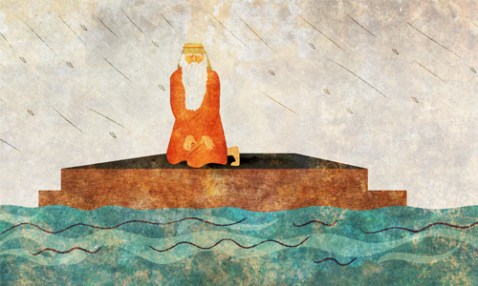
There is an interesting verse in this week’s Parsha regarding G-d’s command to Noach to build an ark, due to the decree of the approaching flood. “A window (tzohar in Hebrew) shall you make for the Ark, and to a cubit finish it from above.” (Chapter 6, Verse 16) Rashi brings two options from the Midrash Raba regarding what the tzohar actually was: some of the Sages say it was a window (as translated above), like a skylight, and others say it was a precious, shining stone.
Based on this verse from the Parsha, Rebbe Nachman brings an amazing teaching about truth. When a person stands in prayer before G-d, many times he finds it hard to pray properly with intention and find the words he wants to express because of the bad thoughts and bad spiritual forces which come against him and surround him. He finds himself in spiritual darkness and he can’t pray. Rebbe Nachman says that the rectification and the advice for this situation is to express words of truth, whatever words of prayer you can say, say them with truth. Truth is like the shining gem or the rays of sunlight coming through the window. Don’t pray to G-d about something which you don’t even feel connected to at that moment, rather say what’s on your heart at that time. “Hashem I feel really frustrated right now because…please help me.” “This situation is really painful for me, I don’t know what to do, please send me good advice.” By way of the words which come out of your mouth in truth, they will create an opening for you in the darkness which you find yourself and then you’ll be able to pray from the depths of your heart. (Likutei Moharan, Part 1, Teachings 9 & 112)
I learned this teaching in the past year with a friend, and the powerful message of the importance of speaking the truth before G-d made a strong impression on me. He wants our words, to express before him what we are really feeling and going through at that time, and not what we think we are supposed to say or what the voices of others tell us we should say. I feel that this teaching is helping me to be honest with myself when I take time for personal prayer. I try to take some deep breaths and calm and compose myself, listen to my heart and express my thoughts, feelings and desires. I also see that in my marriage, many times I struggle with being open and honest with my wife about something which is causing me doubt or confusion, but when I do share with her my thoughts and feelings it helps me to find clarity and strength.
Rebbe Nachman says in the same teaching mentioned above to remember this principle very well, to seek only the truth, because it’s a great and fundamental point which everything depends upon in the service of G-d. Truth is the light of G-d himself, and if G-d’s light is shining upon us then there’s no darkness which can trap us. G-d wants us to be simple, real and honest, something which in modern times has become more and more difficult for many people. We should all merit to live with this teaching and experience it in our lives, amen.
Bereshit 5779

Here we go, a new year, a new idea.
After spending several years translating other people’s articles on Rebbe Nachman’s teachings, I want to try a new idea this year, sharing a teaching each week on the weekly Torah portion or a special time of the year based upon Rebbe Nachman’s teachings.
A new year, a new idea- this is exactly what I wanted to discuss a little bit, the idea of renewal. Finding the strength and courage to try something new or trying again to obtain something which we might have given up on a long time ago. Starting over. After finishing the yearly reading of the Torah a few days ago on Simchat Torah, we are starting again this coming Shabbat, Parshat Bereshit. Bereshit tells of the creation of the world and the story of Adam and Eve in the Garden of Eden, but I’d like to focus on the first word- Bereshit, which means in the beginning. Beginning again.
Rebbe Nachman teaches in the final lesson which he gave during his lifetime, on Rosh Hashana in 1810, a few weeks before he passed away during the holiday of Succot, (Likutei Moharan II, 8th teaching) that through connecting to a great Tzaddik, by following his advice and teachings a person can merit complete faith, which he says is believing in the renewal of the world, meaning that G-d created the world from absolutely nothing and he continues to renew the world each day. The power and the inspiration to finding renewal, Rebbe Natan explains, can be found in the writings of the Tzaddik, who has the aspect of prophecy, a divine spirit, which we can connect to on our level and feel again vitality and rebirth through these teachings. This year and this day is a completely new creation, even though to our eyes it seems similar to yesterday or to just a month ago, when it was still 5778. However, everything is truly new. This means that just as this reality of renewal exists in the world all the time, so too, we can connect to this power of renewal in our lives, every day.
Many times we start off a new year with a lot of ideas and goals and fresh inspiration, and then at a certain point, due to obstacles or just the monotonous routine we might experience in daily life, we let those goals and new ideas slip away. We also get stuck in regrets about the past instead of trying to start again. That is exactly why renewal is so critical. It doesn’t matter if I wanted to learn something every day for a few minutes and I missed yesterday or the past week, right now I’m starting over, right now I can make a fresh start and go forward. This is also one of the powerful aspects of daily personal prayer or meditation- every day where we find ourselves in our lives and what we are going through is different, and every day the words and prayers we need at that time are new, we can express ourselves anew every day before G-d. This is a major principle which Rebbe Nachman teaches us- don’t despair, keep trying, keep starting anew!
(This article was inspired by a class from Rav Erez Moshe Doron on Likutei Halachot, Hilchot Shluchin, 5th lesson)
 Neveloff Wellness